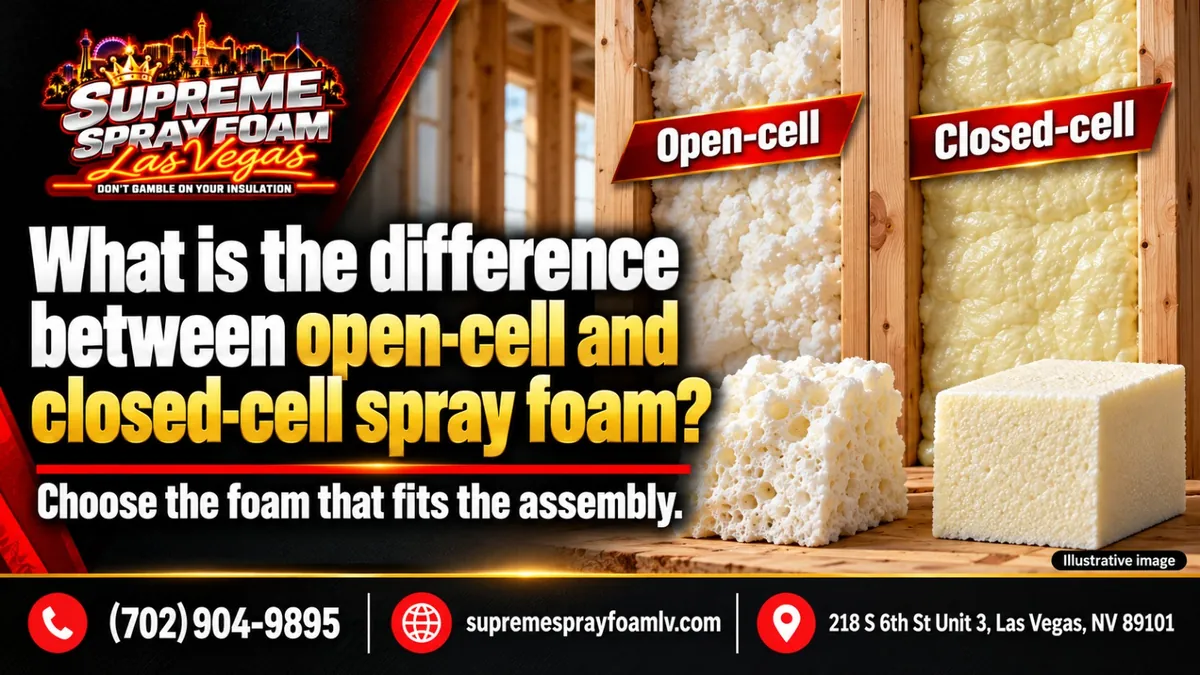
Open-cell spray foam is generally softer, less dense, and more permeable to water vapor. Closed-cell spray foam is generally more rigid, denser, and has higher thermal resistance per inch. Both can contribute to insulation and air sealing when installed to their product requirements. The better choice for a Las Vegas property depends on the space, moisture conditions, and design of the wall or roof assembly.
Illustrative campaign artwork. Not a photograph of a completed customer project.
What open cell and closed cell mean
The names describe the foam’s cellular structure. In open-cell foam, many cells are interconnected. Closed-cell foam has a greater proportion of enclosed cells. These differences help explain why the products have different density, thermal performance, and vapor behavior.
The Department of Energy spray foam selection guide explains the basic distinctions. Use that as background, then compare the current data sheets for the actual products in your estimate. A general comparison cannot substitute for a product’s tested properties.
| Property | Open cell | Closed cell |
|---|---|---|
| Cell structure | More interconnected cells | More enclosed cells |
| Feel and density | Generally softer and lower density | Generally more rigid and higher density |
| Thermal resistance per inch | Generally lower; more thickness may be needed | Generally higher; useful where space is limited |
| Water vapor movement | Generally more vapor permeable | Generally less vapor permeable; product and thickness matter |
| Air sealing | Can qualify at the documented thickness and installation | Can qualify at the documented thickness and installation |
| Best choice | Depends on assembly, goals and product requirements | Depends on assembly, goals and product requirements |
How much spray foam fits in the space
Closed-cell spray foam generally offers a higher R-value per inch. That can matter where the available cavity is shallow. Open-cell spray foam may need greater thickness to meet the same material R-value target, so the available depth belongs in the discussion.
Avoid comparing two quotes only by the number of inches. Ask for the specified product, the planned total R-value, and the surfaces included. Also ask how framing, gaps, and other thermal paths affect the assembly. A higher material R-value does not automatically fix every source of discomfort in a room.
To accompany your comparison of the two foam types, listen to the podcast on Podbean.
How water vapor changes the decision
Air movement, water vapor diffusion, and a liquid-water leak are different moisture concerns. Open-cell foam is generally more vapor permeable. Closed-cell foam is generally less permeable and may serve as a vapor retarder at an appropriate documented thickness. Neither description means the entire building is waterproof.
A roof or wall needs a plan for drying and moisture management. Las Vegas has a dry climate, but indoor moisture, existing roof leaks, and the construction of an assembly still matter. Ask whether adding the proposed foam changes how the materials can dry. Repair water entry before insulation hides it.
Can both types seal air leaks
Both types can form part of an air barrier when the product’s minimum thickness, coverage, and installation conditions are met. Open-cell does not mean outdoor air must freely pass through a correctly installed layer. Closed-cell does not mean every joint elsewhere in the building becomes sealed.
For either product, ask how the work connects at edges, penetrations, and neighboring surfaces. DOE’s guidance on an air-sealed home emphasizes a complete boundary. The continuity of that boundary is an important part of comparing the proposed scopes.
Which type belongs in a Las Vegas attic
There is no universal answer based only on the city. An attic-floor installation and an installation below the roof deck are different assemblies. The existing ventilation approach, roofing materials, ducts, mechanical equipment, and moisture conditions influence what is appropriate.
Start with the actual attic arrangement and explore attic insulation options. Ask the contractor to explain whether the proposal changes the attic from vented to unvented and how that change will be designed. Do not use the phrase closed-cell or open-cell as a replacement for an assembly plan.
How to compare price and scope
Open-cell foam may be less expensive for some applications, but a useful price comparison needs an equivalent scope and performance target. Access, preparation, thickness, protective coverings, removal, and finish restoration can affect the total. A lower quote that omits required work is not necessarily better value.
Review Supreme Spray Foam LV’s open-cell service and closed-cell service before asking for project-specific options. Request written explanations of the product choice and exclusions rather than an unsupported price per square foot. For a Las Vegas-focused look at where each foam tends to fit, see our guide Open Cell vs Closed Cell Spray Foam: Which Is Better in Las Vegas, NV?
You can also listen to the audio on SoundCloud while reviewing the insulation options for your property.
Questions to include in your estimate
Ask which named product will be installed, what total insulation target it will meet, and whether the available space is sufficient. Request the manufacturer’s technical information and ask how the installer will check coverage, adhesion, and the finished thickness.
Also ask which protective covering is required, whether separate vapor control is needed, and who handles existing leaks or damaged materials. Confirm application ventilation and product-specific reentry instructions. The EPA safety overview is background for that discussion; it does not establish a single waiting time for every project.
Choose a product after assessing your property
Tell Supreme Spray Foam LV whether the concern is an attic, wall, or another part of the building. Describe access limitations and any known moisture issues. The business serves Las Vegas, Paradise, Henderson, and Spring Valley.
Request an insulation assessment or call (702) 904-9895. Ask for an explanation of both options where appropriate, then select the scope that fits the property and your goals.
Find Supreme Spray Foam LV
218 S 6th St Unit 3, Las Vegas, NV 89101. Contact the business before visiting.