Yes, poor insulation is a definite factor contributing to the loss of value in Las Vegas commercial buildings. The relationship is direct: inefficient thermal performance leads to dramatically increased operational costs, specifically for cooling, which immediately reduces the property’s Net Operating Income (NOI). Because commercial appraisal values are often calculated based on capitalizing the NOI, higher operating expenses directly translate into lower valuation. Given the extreme heat of the Mojave Desert, inadequate insulation in roofs and walls quickly becomes the single largest drain on profitability.
Building owners and commercial real estate investors must view insulation not merely as a construction material but as a critical, high-ROI operational asset. The consistent 100°F+ summer temperatures in Las Vegas expose every flaw in a building’s thermal envelope, leading to financial penalties that compound year after year. Understanding how this performance deficit impacts the bottom line and property integrity is essential for maintaining or improving asset value.
The Financial Calculation of Poor Thermal Performance
In commercial real estate, valuation is closely tied to the cost of running the building. The primary driver of expense in the Las Vegas climate is cooling. When a building struggles to maintain temperature stability due to low R-value or thermal bridging, the HVAC system must run constantly, demanding high energy consumption.
According to analysis published by the U.S. Department of Energy (DOE), commercial buildings located in hot and arid climates like Las Vegas spend a disproportionately large portion of their energy budget on cooling and ventilation. If an older building uses conventional insulation that has degraded or settled, its effective R-value drops significantly. This forces the use of oversized HVAC equipment or the premature replacement of existing units, adding capital expenditure risks that depress investor interest and market value.
Impact on Net Operating Income (NOI)
Commercial property valuation is often determined by the formula: Value = NOI / Capitalization Rate. When energy bills increase by 20% to 40% due to poor insulation, the NOI decreases by the same amount. This is not a subtle reduction; it’s a direct subtraction from the cash flow available to investors, immediately lowering the appraised market value. An energy-efficient building is more attractive to potential buyers and tenants, which can increase its market value.
Consider this real-world implication: A $10,000 annual reduction in cooling costs achieved through effective insulation could translate to a $150,000 to $250,000 increase in asset value, depending on the local capitalization rate.
Insulation Performance in High-Temperature Climates
The goal of insulation in Las Vegas is less about keeping heat in and more about keeping heat out. R-value measures thermal resistance, and in desert environments, high R-values are crucial. However, the chosen material matters because not all insulation maintains its stated R-value effectively under extreme heat or humidity fluctuations.
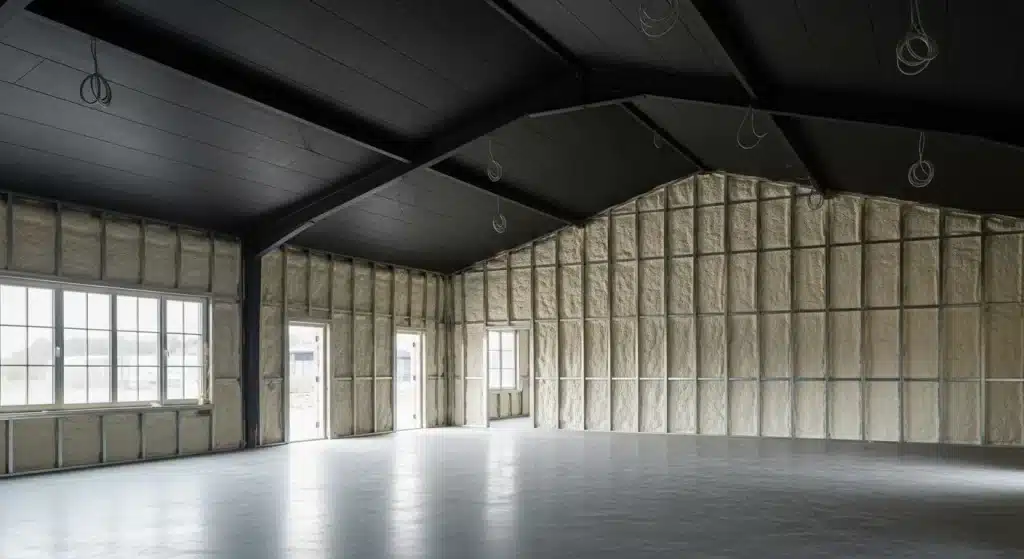
Traditional batt insulation can suffer from air permeability and settling over time, creating gaps where heat bypasses the barrier. Air leaks are responsible for significant heat gain. High-density, monolithic materials that address both air sealing and thermal resistance provide superior performance in this environment. This level of comprehensive performance is often necessary to meet modern energy codes and tenant demands for comfort.
Comparison of Commercial Insulation Types
To manage the heat load effectively, property managers need to evaluate how different materials perform under the intense solar radiation typical of Las Vegas.
Hidden Damage and Accelerated Material Degradation
Beyond energy bills, poorly insulated commercial buildings face hidden costs that erode structural longevity. Roof assemblies, in particular, bear the brunt of thermal shock. Daily temperature swings in Las Vegas can be dramatic, causing extreme expansion and contraction cycles on roofing membranes and structural framing. Inefficient insulation allows heat to pass through the ceiling structure, stressing the roof from the underside as well as the top.
Research published by the National Institute of Standards and Technology (NIST) has explored how uncontrolled heat transfer contributes to premature degradation of building materials. Roofing materials, sealants, and adhesive layers break down faster when subjected to extreme temperature cycling facilitated by inadequate thermal barriers. Replacement costs for these high-dollar components significantly reduce the property’s effective useful life.
Bonus Tip 1: Conduct thermal imaging scans during the hottest part of the day. These scans instantly visualize where heat is penetrating the building envelope, highlighting insulation gaps, failed roofing systems, or areas suffering from severe thermal bridging (where heat bypasses insulation through structural members).
Key Considerations Before Upgrading Commercial Insulation
An insulation upgrade is a major capital improvement that demands careful planning to ensure maximum return on investment. Before committing to a specific material or scope, property owners should focus on a thorough preliminary assessment.
- Comprehensive Energy Audit: A qualified energy auditor should assess the entire building envelope, identifying all sources of thermal loss, including walls, roofs, slab edges, and air ducts. This pinpoints areas where capital investment will yield the greatest savings.
- Long-Term Strategy: Evaluate the desired R-value not just for compliance, but for long-term operational efficiency. Las Vegas energy standards, often based on the International Energy Conservation Code (IECC), may increase over time, so designing for higher R-values now prevents obsolescence later. The IECC sets minimum energy efficiency provisions for commercial buildings.
- Moisture Management: While Las Vegas is arid, condensation occurs when humid indoor air meets cold surfaces (often associated with high-capacity cooling). The chosen insulation must manage vapor permeability to prevent hidden mold and mildew issues that threaten tenant health and structural integrity.
Bonus Tip 2: Review existing warranty documentation for the roof and HVAC system. Many manufacturers void warranties if the new insulation application conflicts with their specifications, especially regarding weight or installation methods.
Addressing Specific Commercial Property Concerns
One common concern is minimizing disruption during installation, especially for high-rise or retail properties where ongoing operations are sensitive. Phased installation, prioritizing areas with the highest heat gain (typically the roof), allows businesses to remain open while the work is performed. Coordination with tenants regarding temporary noise or access restrictions is key to maintaining positive business relationships.
Another point of concern is the initial investment cost. While insulation upgrades can be costly upfront, they represent preventative maintenance against escalating utility costs and accelerated depreciation. These savings often amortize the initial cost quickly, sometimes within five to seven years, significantly increasing the long-term cash flow of the asset.
Bonus Tip 3: Check local utility providers and federal programs for commercial energy efficiency rebates or tax deductions. These programs can significantly offset the immediate cost of high-performance insulation materials, improving the project’s overall financial feasibility.
Evaluating Your Property’s Thermal Health
If the building’s current insulation is twenty years old or older, or if cooling bills seem unusually high compared to similar properties, a professional evaluation is necessary. Proactive measures stop the downward slide of property value and position the asset favorably for sale or refinance by showcasing superior operational efficiency. Assessing the integrity of the thermal envelope is a straightforward investment in future asset performance. Ensure any professional assessment of thermal performance considers the specific and demanding climate of Southern Nevada.
What is Thermal Bridging and Why Does it Matter in Las Vegas?
Thermal bridging occurs when heat travels through highly conductive materials, like steel studs or wooden joists, bypassing the insulation layer entirely. In the summer, these bridges act like heat conduits, drawing external heat directly into the cool interior. Eliminating thermal bridging is essential in hot climates to achieve the maximum effective R-value and prevent hot spots on interior walls and ceilings.
Does Adding Insulation Affect Fire Safety Ratings?
Yes, the type of insulation material used can affect fire safety. Commercial-grade insulation products, especially foam materials, must meet strict fire rating standards (Class A or better) and smoke development requirements. Always ensure the chosen product is compliant with local Las Vegas building codes and has been installed according to manufacturer specifications to maintain safety ratings.
Can New Insulation Reduce Noise Levels for Tenants?
High-performance insulation often provides excellent acoustic benefits alongside thermal resistance. Dense materials, like high-density foam or thick mineral wool, can significantly reduce sound transfer between floors or from external sources like traffic or HVAC equipment. This quiet environment is a substantial amenity for tenants, improving lease retention and satisfaction.
How Do Tenants Benefit from Better Insulation?
Tenants experience superior comfort control, fewer drafts, and stabilized indoor temperatures, leading to fewer complaints and greater productivity. Moreover, lower energy consumption allows building owners to offer more competitive lease rates (in full-service leases) or ensures tenants’ utility bills remain predictable and manageable.
Taking Control of Operational Expenses
The performance of a commercial building’s thermal envelope dictates its long-term financial stability in Las Vegas. Owners must treat insulation upgrades as a strategic financial decision, ensuring their properties are equipped to handle the extreme heat efficiently and reliably. A thorough thermal assessment is the necessary first step toward preserving and enhancing property value.
Requesting Expert Evaluation
Understanding the specific thermal challenges facing your commercial structure requires expert evaluation focused on high-heat applications. Property managers looking for detailed assessments of their existing thermal envelope and tailored upgrade solutions are encouraged to seek professional guidance. Contact Supreme Spray Foam LV for detailed information on minimizing heat gain and maximizing R-value retention. Experts can be reached directly via email at info@supremesprayfoamlv.com or by phone at (702) 904-9895 to discuss property requirements and long-term energy goals.
Sources
- U.S. Department of Energy (DOE): Reference for commercial building energy usage and cooling load intensity in hot, arid climates.
- National Institute of Standards and Technology (NIST): Information regarding the impact of uncontrolled heat transfer and thermal shock on the longevity and degradation of roofing and building materials.
- Journal of Real Estate Research: Discusses the capitalization effect of energy efficiency improvements on commercial property valuation and Net Operating Income (NOI).