
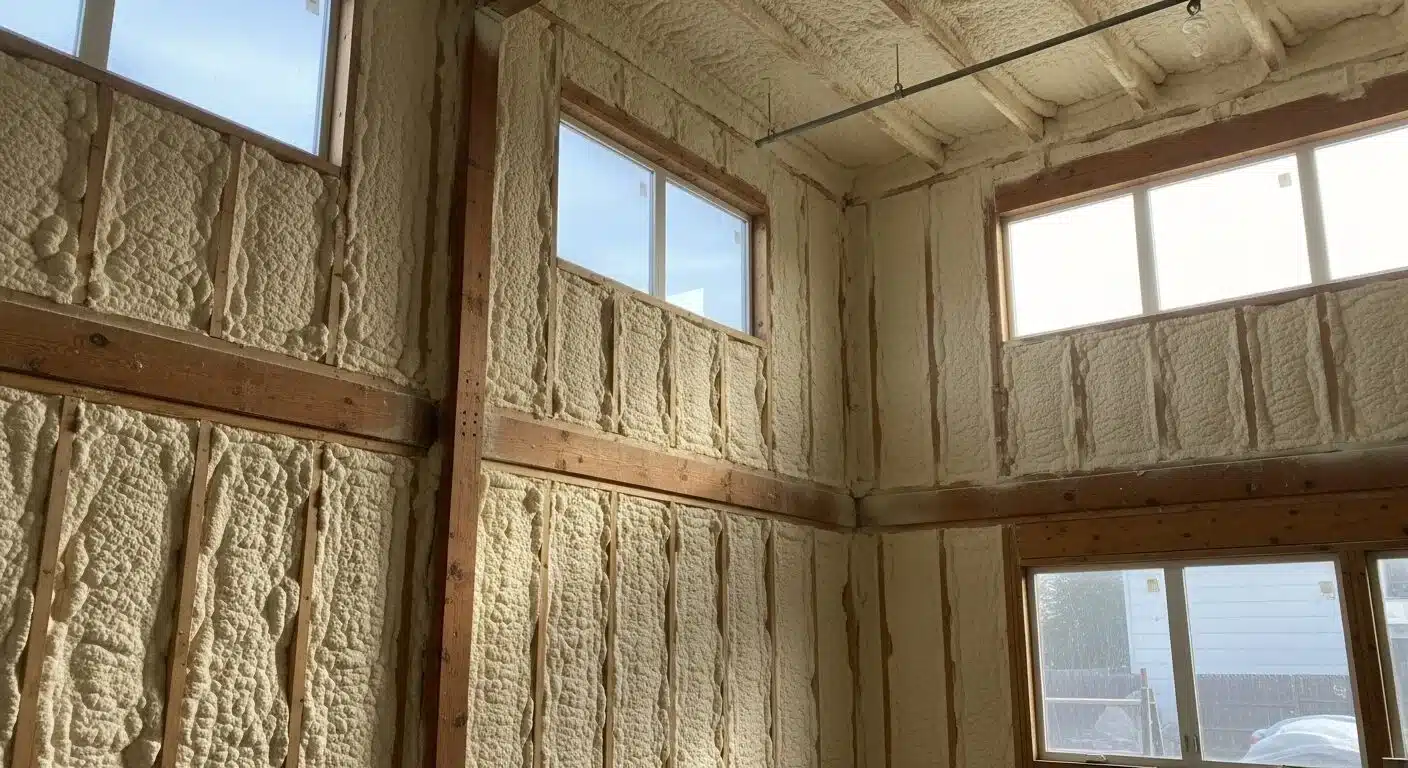
Choosing the right spray foam insulation for a Kyle Canyon property comes down to three factors: your home’s elevation and exposure to mountain weather, the specific areas you need to insulate, and whether your project calls for open-cell or closed-cell spray foam. Kyle Canyon sits above 4,000 feet in Clark County, which places it in Climate Zone 5B under Nevada’s energy code, meaning insulation requirements are stricter than the lower desert floor. The two main spray foam categories, open-cell and closed-cell, serve different purposes, and selecting the correct one impacts everything from energy savings to moisture control and long-term durability.
TLDR / Key Takeaways
- Kyle Canyon properties fall under Climate Zone 5B due to elevation, requiring higher R-values than the Las Vegas valley floor
- Open-cell spray foam delivers approximately R-3.7 per inch and works best for interior walls, ceilings, and sound dampening
- Closed-cell spray foam reaches R-6.5 to R-7.0 per inch and serves as both insulation and a moisture vapor barrier
- Closed-cell foam adds structural rigidity to walls and roof assemblies, making it preferred for mountain-exposed areas
- Minimum code requirements for Climate Zone 5B include R-49 ceiling insulation and R-20 wall insulation under the 2024 IECC
- Mixing both foam types within the same property is a common and cost-effective strategy
- Professional installation matters more than the foam product itself for long-term performance
Why Kyle Canyon Properties Demand More From Insulation
Most of Southern Nevada sits in a hot, arid climate zone where cooling loads dominate. Kyle Canyon is different. At elevations ranging from roughly 4,000 to over 7,000 feet, the canyon experiences significantly colder winters than the Las Vegas valley, with regular freezing temperatures, snow accumulation, and high winds. This dual climate, hot summers and genuinely cold winters, means your property needs insulation that performs in both directions.
The Las Vegas Energy Code specifically addresses this: areas within Clark County above 4,000 feet in altitude are classified as Climate Zone 5B, not the lower desert zones. That classification change drives up the minimum required R-values for nearly every building assembly. Homes that were built to valley-floor standards will underperform in Kyle Canyon, leading to higher heating costs, drafts, and potential moisture issues from condensation.
Line Chart Suggestion: A dual-axis chart comparing average monthly temperatures in Kyle Canyon versus the Las Vegas valley floor, overlaid with heating and cooling degree days, would visually demonstrate why canyon properties face a wider insulation performance demand.
Open-Cell vs. Closed-Cell Spray Foam: A Clear Breakdown
Understanding the two primary spray foam types is the foundation of making the right choice. While both are applied as a liquid that expands and cures into a solid foam, their physical properties and ideal applications differ substantially.
According to Johns Manville’s technical breakdown, closed-cell spray foam achieves an R-value of approximately R-7 per inch, while open-cell spray foam delivers roughly R-3.8 per inch. That difference in thermal resistance per inch is significant when you are working within limited framing cavities.
| Property | Open-Cell Spray Foam | Closed-Cell Spray Foam |
|---|---|---|
| R-Value Per Inch | ~R-3.7 | ~R-6.5 to R-7.0 |
| Density | Low (0.5 lb/ft³) | High (1.5 to 2.0 lb/ft³) |
| Expansion Rate | Up to 100x its volume | 30 to 40x its volume |
| Vapor Permeability | Vapor permeable (breathable) | Acts as a vapor barrier (Class II) |
| Moisture Resistance | Absorbs water if exposed | Resists water absorption |
| Structural Strength | Minimal | Adds shear strength to assemblies |
| Sound Dampening | Excellent | Good |
| Cost Per Board Foot | Lower | Higher (roughly 1.5 to 2x) |
| Best Applications | Interior walls, ceilings, sound walls | Foundations, crawlspaces, rim joists, exterior walls |
Where Each Foam Type Performs Best in a Kyle Canyon Home
Closed-Cell Foam: The Workhorse for Exterior and Below-Grade Assemblies
For Kyle Canyon properties, closed-cell foam is the logical choice anywhere the building envelope meets extreme temperatures or moisture exposure. This includes:
- Rim joists and band joists: These areas are notoriously leaky and hard to insulate with fiberglass batts. Closed-cell foam seals gaps and provides a high R-value in a thin layer.
- Crawlspace walls and floors: Kyle Canyon homes with crawlspaces face cold ground temperatures and potential moisture migration. Closed-cell foam acts as both insulation and a vapor barrier in one application.
- Exterior wall cavities: When framing depth is limited, closed-cell delivers more R-value per inch than any other common insulation material.
- Roof deck assemblies: Cathedral ceilings and flat roof assemblies benefit from closed-cell foam applied directly to the underside of the roof deck, where it prevents ice dam formation and condensation.
The structural benefit is worth noting, too. Closed-cell foam adheres to framing members and sheathing, adding shear strength to wall and roof assemblies. In a canyon environment where high winds are a regular occurrence, that added rigidity provides real value.
Open-Cell Foam: The Smart Choice for Interior and Large-Volume Spaces
Open-cell foam excels in areas where high R-value per inch is less critical, but air sealing, sound control, and coverage speed matter more. Its lower cost per board foot makes it attractive for larger projects.
- Interior partition walls: If sound control between rooms is a priority, open-cell foam absorbs sound waves better than closed-cell due to its softer, more porous structure.
- Attic floors (vented attic assemblies): When insulating the attic floor above conditioned space, open-cell foam provides excellent air sealing at a lower material cost.
- Bonus rooms and great rooms: Large, open ceiling cavities that do not require a vapor barrier performance benefit from open-cell coverage.
- New construction wall cavities: In 2×6 framed walls where you have the depth, open-cell foam at full cavity depth can achieve total R-values in the low-to-mid R-20 range at a lower installed cost than closed-cell.
The trade-off is that open-cell foam is vapor-permeable. In Kyle Canyon’s cold winters, this means it should not be used in locations where warm indoor air could reach a cold surface and condense inside the wall cavity without a separate vapor barrier in place.
Matching Insulation Strategy to Your Property Type
Not every Kyle Canyon property faces the same conditions. The right strategy depends on your home’s specific construction, age, and exposure.
| Property Type | Recommended Strategy | Key Considerations |
|---|---|---|
| New construction, full build | Closed-cell in walls and roof deck, open-cell in interior partitions | Maximum energy efficiency from day one |
| Existing home retrofit | Closed-cell in rim joists and crawlspaces, open-cell in attic floor | Prioritize the worst air leakage points first |
| Cabin or second home | Closed-cell in all envelope assemblies | Unoccupied periods in winter require the best thermal protection |
| Mountain-exposed (ridge or north-facing) | Closed-cell dominant throughout | Wind-driven rain and snow demand maximum moisture resistance |
| Sheltered canyon floor location | Balanced mix of both types | Lower wind exposure allows more flexibility with open-cell |
Bar Chart Suggestion: A side-by-side cost comparison chart showing estimated installed costs per square foot for open-cell versus closed-cell foam across common application areas (rim joist, wall cavity, attic floor, crawlspace).
Climate Zone 5B Code Requirements and What They Mean for Your Project
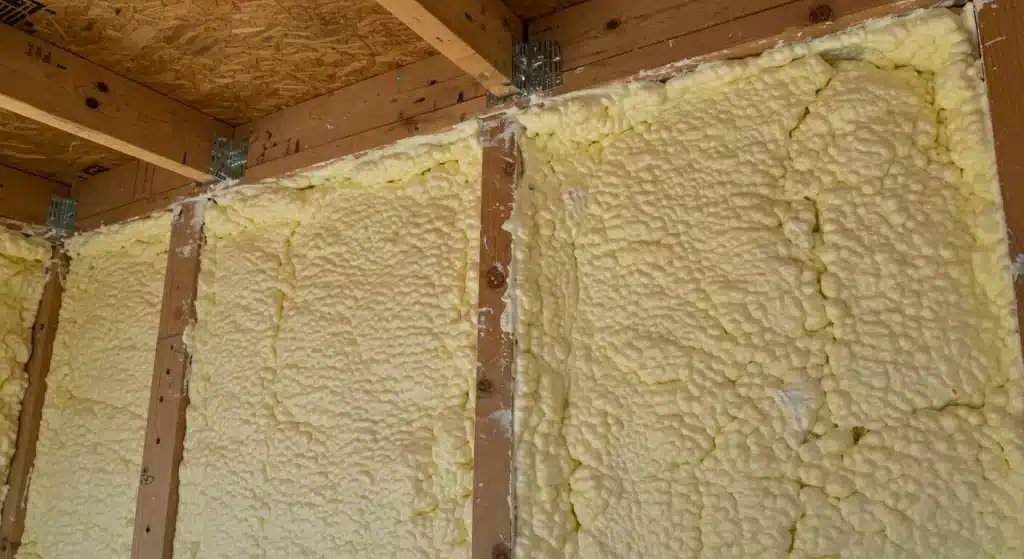
Under the 2024 IECC amendments adopted by Clark County, Climate Zone 5B residential buildings must meet minimum insulation R-values that exceed what many homeowners expect for Southern Nevada. The key requirements include:
- Ceiling/attic: R-49 minimum for standard attics, R-38 for cathedral ceilings
- Wood frame walls: R-20 minimum cavity insulation or R-13 cavity plus R-5 continuous insulation
- Floors over unconditioned spaces: R-30 minimum
- Crawlspace walls: R-15 minimum (when conditioned crawlspace approach is used)
These are minimums. For Kyle Canyon, we generally recommend exceeding code minimums, especially on the windward side of the structure and in any north-facing assemblies. The incremental cost of adding an extra inch of closed-cell foam during installation is small compared to the long-term energy savings.
Signs You Have Chosen the Right Insulation Approach
A well-planned spray foam insulation project shows clear indicators of quality, both during the planning process and after installation. Here is what to look for:
- Your contractor performs a pre-installation assessment that includes a discussion of your home’s specific elevation, orientation, and exposure rather than offering a generic quote
- The proposal separates open-cell and closed-cell applications by area instead of quoting one product for the entire job
- Air sealing is treated as a primary goal, not a side benefit, with attention to penetrations, top plates, and rim joists
- Installation depth targets are specified clearly and tied to your home’s required R-values, not just filled cavities
- Moisture management is addressed explicitly, including whether a separate vapor barrier is needed with open-cell applications
- Your contractor can explain code compliance for Climate Zone 5B without hesitation
Common Mistakes to Avoid
Choosing the right foam type matters, but avoiding these frequent missteps matters just as much:
- Using only open-cell foam in below-grade applications. Open-cell absorbs water, which can lead to mold and structural damage in crawlspace or basement installations.
- Ignoring air sealing and relying solely on R-value. Even high-R insulation underperforms if air is moving through the building envelope.
- Not accounting for the thinner cavity depths in older homes. If your home has 2×4 framing (3.5-inch cavities), closed-cell is often the only way to reach code-required wall R-values.
- Choosing foam type based purely on price. The lower per-board-foot cost of open-cell can be misleading if you need the performance characteristics that only closed-cell provides.
- Skipping a post-installation thermal scan. Infrared imaging after installation confirms complete coverage and identifies any gaps before walls are closed up.
Get Expert Guidance for Your Kyle Canyon Property
Choosing between open-cell and closed-cell spray foam for a Kyle Canyon home involves weighing climate zone requirements, building assembly specifics, moisture exposure, and budget. At Supreme Spray Foam LV, we work with mountain and canyon properties throughout the Las Vegas area and understand the unique demands that elevation and exposure place on your insulation system. We assess every project individually and recommend the right foam type for each specific area of your home rather than applying a one-size-fits-all approach.
Call us at (702) 904-9895 or email [email protected] to discuss your Kyle Canyon insulation project with a team that knows mountain properties inside and out.
FAQs
Can I use both open-cell and closed-cell foam in the same house?
Yes, and in many Kyle Canyon homes, this is the most cost-effective approach. Closed-cell foam is used where moisture resistance and high R-value per inch are critical, such as rim joists, crawlspaces, and exterior walls. Open-cell foam is then used in interior partitions and attic floor assemblies where its lower cost and sound-dampening qualities are advantages.
How does Kyle Canyon’s elevation affect my insulation needs?
Properties above 4,000 feet in Clark County are classified under Climate Zone 5B rather than the hotter desert zones USDA SNOTEL. This means the building code requires higher minimum R-values for walls, ceilings, and floors. Your home also faces colder winters with regular freezes, which demand insulation that performs well in both heating and cooling seasons.
Is closed-cell spray foam worth the higher cost for my project?
Closed-cell foam costs roughly 1.5 to 2 times more per board foot than open-cell, but it delivers nearly double the R-value per inch and acts as a vapor barrier. For below-grade applications, exposed rim joists, and any assembly where moisture is a concern, closed-cell is the correct choice regardless of cost. For large interior cavity fills where vapor permeability is acceptable, open-cell may provide better value.
How long does spray foam insulation last in a mountain environment?
Properly installed spray foam insulation is a permanent building material. It does not settle, sag, or degrade over time like fiberglass batts. Both open-cell and closed-cell foams are designed to last the life of the structure, though closed-cell foam’s moisture resistance makes it particularly well-suited for the wetter, colder conditions found at higher canyon elevations.
Will spray foam insulation help with drafts and cold spots in my existing home?
Spray foam is one of the most effective air sealing materials available. When applied to rim joists, wall cavities, and attic penetrations, it eliminates the air leaks that cause drafts and cold spots. Many homeowners notice an immediate improvement in comfort and a reduction in heating costs after retrofitting problem areas with spray foam.
Sources
- Las Vegas Energy Code 2024 – Chapter 3 General Requirements (UpCodes) – Climate zone classifications for Clark County, including the 4,000-foot elevation threshold for Zone 5B designation.
- Johns Manville – Spray Foam: Open-Cell vs. Closed-Cell – Technical comparison of R-values, density, and performance characteristics for open-cell and closed-cell spray foam.
- Clark County 2024 IECC Code Amendments – Minimum insulation R-value requirements by climate zone and building assembly for residential construction.
- Barrier South – Open-Cell vs. Closed-Cell Breakdown – Side-by-side performance comparison covering expansion rates, structural benefits, and application guidance for each foam type.
- USDA SNOTEL – Kyle Canyon Site Information – Historical weather and snowpack data for the Kyle Canyon measurement station at approximately 7,600 feet elevation.