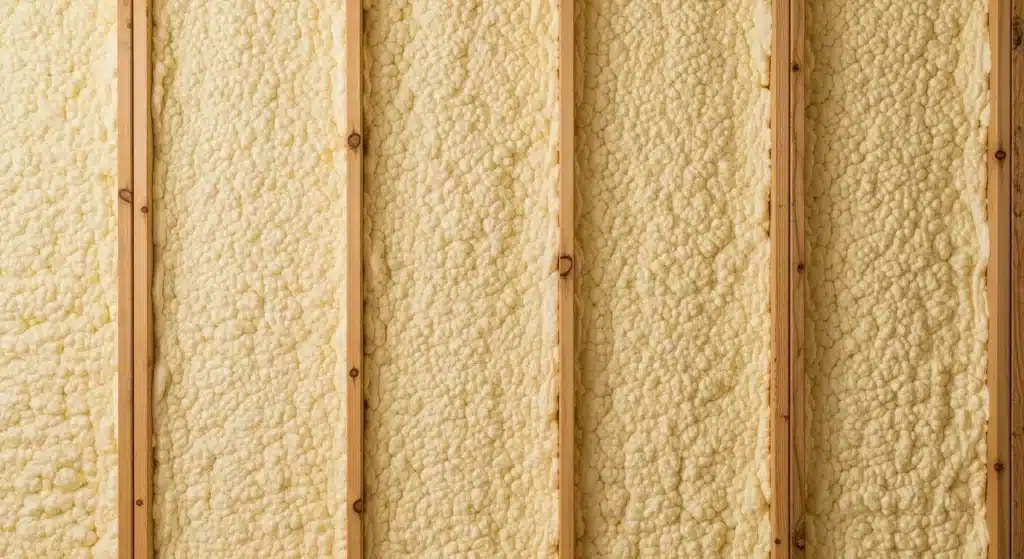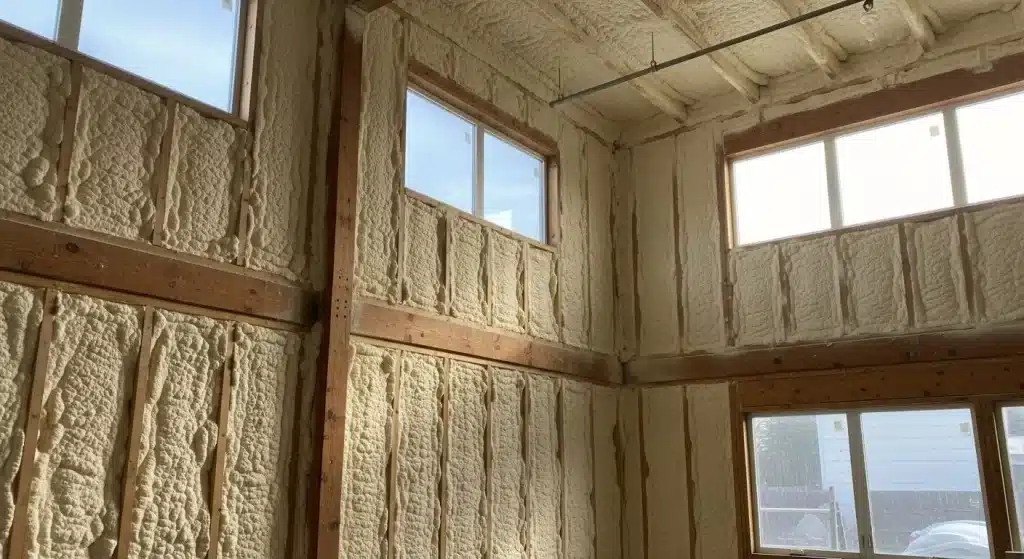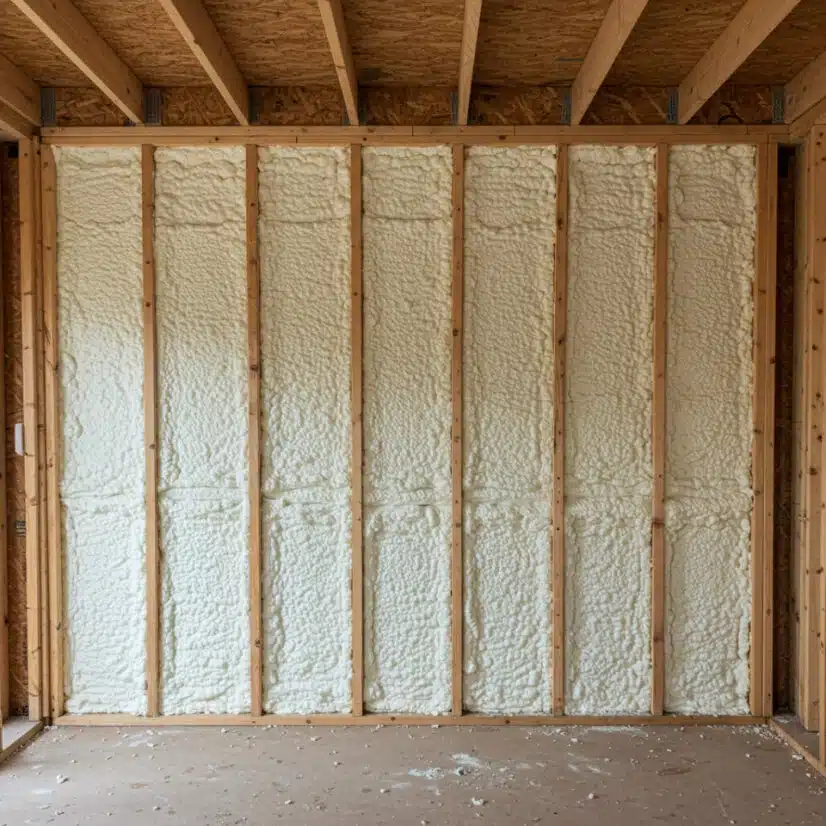

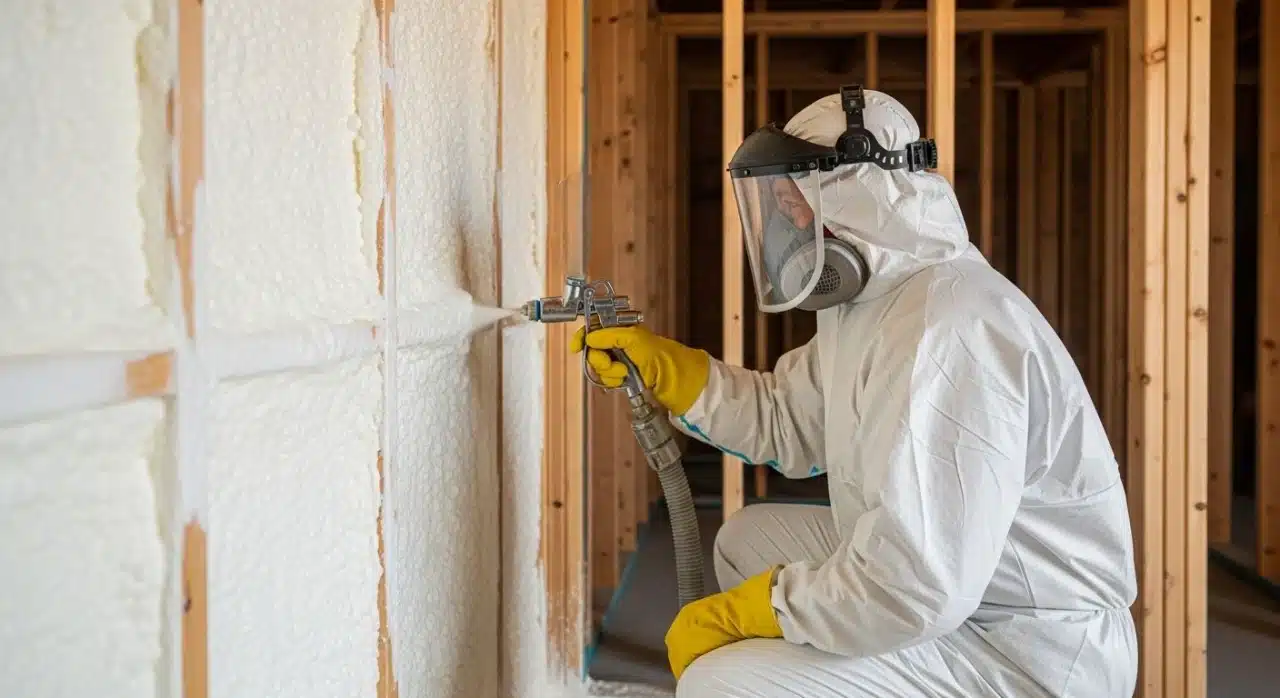
Closed-cell spray foam consistently outperforms traditional attic insulation materials like fiberglass batts and blown cellulose in barn environments because it delivers higher R-value per inch, acts as a built-in vapor barrier, seals air leaks completely, and adds structural rigidity to walls and roofs. For barn owners managing livestock, storing temperature-sensitive equipment, or protecting feed and supplies, the right insulation choice depends on controlling moisture, preventing condensation on metal surfaces, and maintaining stable interior temperatures through seasonal extremes. Traditional attic insulation was designed for conditioned residential spaces, not the high-humidity, high-temperature-swing environments that barns and agricultural buildings present. Closed-cell spray foam, by contrast, was built for exactly these demanding conditions.
TLDR / Key Takeaways
- Closed-cell spray foam delivers R-6.0 to R-7.5 per inch, roughly 30 to 70% better thermal performance than fiberglass batts of the same thickness
- At just 2 inches of depth, closed-cell foam achieves less than 1 perm of vapor permeance, qualifying as a Class II vapor retarder that prevents condensation damage inside metal barn walls
- Traditional attic insulation like fiberglass does not seal air gaps, allowing drafts, moisture infiltration, and significant energy loss around studs, joints, and framing
- Closed-cell foam adheres directly to metal roofing and siding, eliminating the gap where condensation typically forms and corrodes steel panels
- Closed-cell spray foam adds structural strength to pole barn walls and roof decking, increasing racking resistance by an estimated 20 to 40%
- The higher upfront cost of closed-cell foam is offset by lower heating and cooling expenses, reduced maintenance from moisture damage, and a lifespan that matches or exceeds the building itself
- Fiberglass insulation in barns is prone to sagging, moisture absorption, mold growth, and pest nesting, all of which degrade performance over time
- For livestock barns specifically, air sealing and moisture control from closed-cell foam directly contribute to healthier animal environments and lower ventilation costs
The Fundamental Problem With Using Attic Insulation in Barns
Traditional attic insulation, including fiberglass batts, blown-in cellulose, and mineral wool, was developed for residential and commercial buildings with controlled indoor environments. These materials rely on being installed inside wall cavities or ceiling joists within conditioned, dry spaces. Barns are an entirely different challenge.
Most barns and pole buildings feature exposed metal roofing and siding, large open spans, frequent door openings, and high interior humidity from livestock respiration, wash-down areas, and stored crops. When fiberglass or cellulose is installed in these environments, several problems quickly emerge. The material does not adhere to metal surfaces, leaving a gap where warm, moist air meets cold steel. That temperature differential causes condensation, which drips onto fiberglass and saturates it. Wet fiberglass loses its insulating properties, supports mold growth, and can sag or collapse out of framing cavities.
The U.S. Department of Energy’s Building America program has documented that spray foam’s ability to serve simultaneously as insulation, air barrier, and vapor retarder makes it uniquely suited for buildings where moisture control is a primary concern, which describes virtually every working barn.
How Closed Cell Spray Foam Solves Barn-Specific Challenges
Closed-cell spray foam is a rigid, dense polyurethane material that expands and cures into a solid layer directly bonded to the substrate it contacts. For barns, this matters in several specific ways.
Moisture Control and Condensation Prevention
The single biggest threat to any barn’s longevity and usability is moisture. Metal roofing and siding condense water when interior humidity meets cold exterior surfaces. According to Armorthane’s spray foam R-value analysis, closed-cell foam delivers R-6 to R-7 per inch and functions as a moisture vapor barrier, keeping warm, humid interior air from ever reaching the cold metal surface. Fiberglass batts cannot do this because they are porous and air-permeable. Moisture passes right through them, condenses on the metal, and drips back into the insulation.
At 2 inches of applied thickness, closed-cell foam drops below 1 perm of vapor permeance, meeting the International Residential Code definition of a Class II vapor retarder. This means no additional vapor barrier membrane is needed in most configurations, simplifying installation and reducing material costs.
Air Sealing That Traditional Insulation Cannot Match
Fiberglass and cellulose slow heat transfer through conduction, but they do nothing to stop air movement through gaps, cracks, joints, and penetrations. In a barn with dozens of wall panel overlaps, door frames, ridge vents, and eave openings, air leakage accounts for a substantial percentage of total energy loss.
Closed-cell foam expands into every crack and crevice during application, creating a continuous seal. Hansen Pole Buildings notes that this air sealing capability can eliminate the need for separate weatherization steps like house wrap or tape-sealed joints, saving both material and labor.
Structural Reinforcement
Closed-cell spray foam cures into a rigid material that bonds to framing, roofing, and siding. In pole barns and post-frame buildings, this added rigidity increases the wall and roof assembly’s resistance to racking and wind loads. For large, open barn structures that lack the shear panels found in conventional framed buildings, this structural benefit of close cell is a meaningful advantage that traditional insulation cannot offer.
Head-to-Head Comparison: Closed Cell Foam vs. Traditional Attic Insulation in Barns
| Factor | Closed Cell Spray Foam | Fiberglass Batts / Blown Cellulose | Winner for Barns |
|---|---|---|---|
| R-Value per Inch | R-6.0 to R-7.5 | R-2.9 to R-3.8 | Closed-cell foam |
| Air Sealing | Seals all gaps and penetrations | Does not seal air leaks | Closed-cell foam |
| Vapor Barrier | Class II retarder at 2 inches | Not a vapor barrier | Closed-cell foam |
| Adhesion to Metal | Bonds directly to steel panels | Requires separate framing or facing | Closed-cell foam |
| Moisture Resistance | Impermeable; does not absorb water | Absorbs moisture, loses R-value | Closed-cell foam |
| Mold Resistance | Does not support mold growth | Prone to mold when wet | Closed-cell foam |
| Pest Resistance | Rigid, no nesting material | Fiberglass provides nesting cavities | Closed-cell foam |
| Structural Benefit | Adds racking strength | No structural contribution | Closed-cell foam |
| Lifespan | Matches building life with no degradation | Sagging, settling, and moisture damage over time | Closed-cell foam |
| Upfront Cost per Sq Ft | Higher ($1.50 to $3.50) | Lower ($0.50 to $1.50) | Traditional insulation |
| Long-Term Operating Cost | Lower energy bills, fewer repairs | Higher bills, moisture maintenance | Closed-cell foam |
Why Barns Specifically Need Closed-Cell Over Other Spray Foam Types
Open-cell spray foam is sometimes suggested as a cost-saving alternative, but it has significant limitations in barn environments. Open-cell foam has a much lower R-value at R-3.5 to R-3.8 per inch and is vapor-permeable, meaning moisture passes through it freely Building Science Corporation. In a barn with metal walls and a roof, open-cell foam would allow condensation to form on the metal behind the foam, causing hidden corrosion and rot that goes undetected until significant damage occurs.
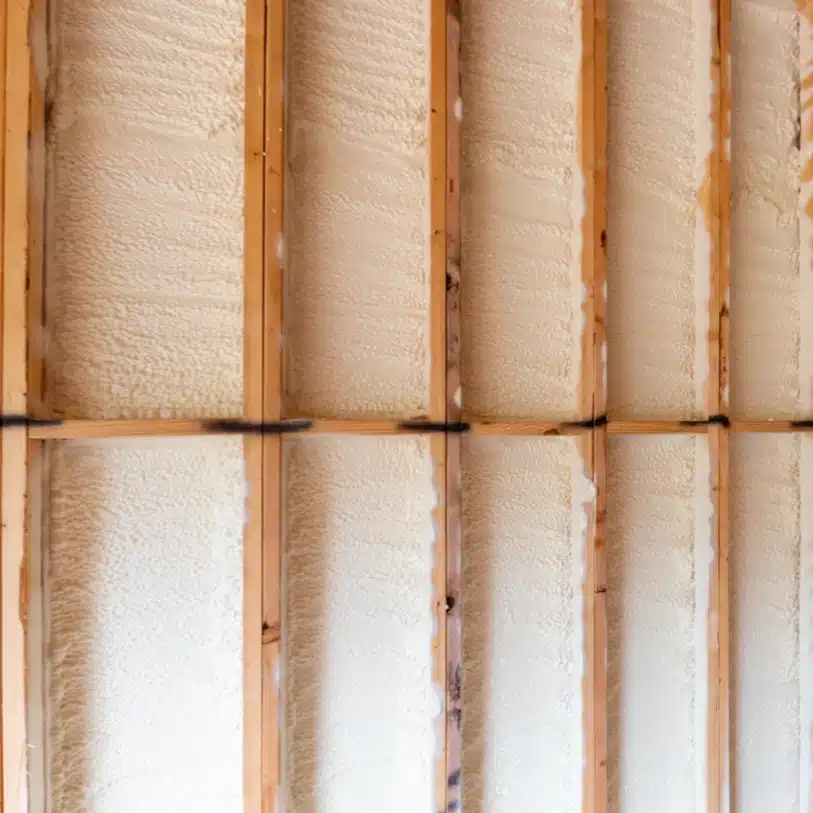
Closed-cell foam eliminates this risk entirely because it is both the insulating layer and the vapor barrier in a single application. For any barn with metal siding or roofing, open-cell foam is not a suitable substitute.
Recommendations by Building Type and Use Case
| Barn Type | Primary Insulation Need | Recommended Approach | Key Considerations |
|---|---|---|---|
| Horse / Livestock Barn | Moisture control, air quality, winter warmth | Closed cell on walls and roof, minimum 1.5 to 2 inches | Ensure ventilation is still adequate; foam seals tightly |
| Equipment / Machinery Storage | Temperature stability, corrosion prevention | Closed cell on the roof deck, walls optional | Focus on preventing condensation on the metal roof |
| Feed / Hay Storage | Moisture prevention, mold avoidance | Closed cell on the roof and upper walls | Protect stored crops from moisture dripping |
| Poultry Barn | Temperature control, ammonia management | Closed cell on walls and ceiling | Pair with proper ventilation systems |
| Workshop / Studio Barn | Year-round comfort, energy efficiency | Closed cell on walls and roof at 2+ inches | Full envelope sealing for conditioned space |
| Cold Storage / Dairy | High thermal performance, wash-down areas | Closed cell at full recommended thickness | Washable surface when coated; superior moisture barrier |
Signs You’ve Chosen the Right Insulation Approach for Your Barn
Knowing that you have made the right insulation decision shows up in practical, day-to-day results rather than just specifications on paper. Here are the indicators that closed-cell foam was the correct choice:
- No condensation on interior metal surfaces during spring and fall temperature swings, which are the most challenging seasons for moisture management
- Stable interior temperatures that require less supplemental heating in winter and less cooling in summer, compared to your previous setup
- No musty odors or visible mold on walls, ceilings, or stored materials, even after heavy rain or high-humidity periods
- Reduced drafts near doors, windows, ridge vents, and eave lines, even when the barn is not fully pressurized
- Lower energy bills that offset the higher upfront investment within the first few years of operation
- No evidence of pest nesting in wall cavities or ceiling spaces, since foam eliminates the void spaces pests prefer
- Contractor communication that included a clear explanation of R-value targets, application thickness, and how the foam addresses moisture specific to your barn type
Common Mistakes When Insulating Barns
Even with the right material, mistakes during planning and installation can undermine performance. Here are the most frequent errors we see:
- Using fiberglass in metal buildings. This is the most common and costly mistake. Fiberglass cannot prevent condensation on metal, and once wet, it becomes essentially useless as insulation.
- Skimping on thickness. Closed-cell foam needs to be applied at the manufacturer-recommended thickness to achieve its rated R-value and vapor retarder classification. Thinner applications save money but sacrifice performance.
- Ignoring ventilation requirements. Foam seals the building envelope tightly, which is excellent for thermal performance but means your ventilation system needs to be properly designed to manage livestock humidity and indoor air quality.
- Not insulating the roof. Many barn owners insulate the walls and skip the roof to save money, but the roof is where the most condensation forms and the most heat escapes. Prioritize roof insulation.
- Choosing open-cell foam for metal buildings. The lower cost is tempting, but open cell’s vapor permeability makes it a poor choice for any structure with metal panels.
Cost Considerations: What to Expect
Closed-cell spray foam has a higher initial cost than traditional insulation, but the total cost of ownership tells a different story. Fiberglass batts may cost $0.50 to $1.50 per square foot installed, while closed-cell spray foam typically ranges from $1.50 to $3.50 per square foot, depending on thickness, accessibility, and geographic location.
However, the real comparison should include:
- Energy savings of 30 to 50% on heating and cooling costs for fully insulated barns
- Elimination of moisture damage repair costs, including metal panel replacement, rot treatment, and mold remediation
- No insulation replacement cycle, since closed-cell foam does not degrade, sag, or require periodic reinstallation
- Reduced HVAC equipment sizing, since a tighter building envelope requires smaller heating and cooling systems
When these factors are included, closed-cell foam often delivers a lower total cost over a 10- to 20-year ownership period despite the higher price tag on day one.
Get Expert Insulation Guidance for Your Barn
Choosing the right insulation for your barn has a direct impact on energy costs, building longevity, and the comfort and health of your livestock or stored goods. At Supreme Spray Foam LV, we specialize in closed-cell spray foam insulation for agricultural buildings, pole barns, and metal structures throughout the Las Vegas region. Our team will assess your building type, intended use, and climate conditions to recommend the right thickness and application approach for maximum performance.
Call us directly at (702) 904-9895 or email [email protected] to get started. We will walk you through your options with honest recommendations and transparent pricing, no guesswork involved.
FAQs
Can I install closed-cell spray foam myself, or do I need a professional?
Closed-cell spray foam requires specialized equipment, proper personal protective equipment, and precise application technique to achieve correct thickness, adhesion, and vapor barrier performance. Professional installation ensures consistent coverage, proper R-value, and warranty coverage that DIY kits cannot match.
How thick should closed-cell foam be applied in a barn?
For most barn applications, 1.5 to 2 inches of closed-cell foam on walls and 2 to 3 inches on roof decking provides strong thermal performance and vapor retarder classification. The exact thickness depends on your climate zone, barn use, and energy goals, which a professional contractor can calculate for your specific building.
Does closed-cell spray foam work on existing barns, or only on new construction?
Closed-cell spray foam can be applied to existing barns and is often used in retrofit projects. It adheres to clean metal, wood, and concrete surfaces. The main consideration is ensuring surfaces are dry and free of loose rust, dirt, or oil before application for proper bonding.
How does closed-cell foam handle barn fires compared to fiberglass?
Closed-cell spray foam is a petroleum-based product and requires a thermal or intumescent barrier (like drywall or a fire-resistant coating) in occupied spaces per building codes. In agricultural buildings, code requirements vary by jurisdiction and occupancy type. Fiberglass is inherently fire-resistant but provides no structural, air-sealing, or moisture-control benefits.
Will insulating my barn with closed-cell foam cause moisture to get trapped inside?
This is a common concern, but closed-cell foam actually prevents moisture from reaching the cold metal surface where condensation would form. The foam keeps the interior surface temperature above the dew point, which is the mechanism that stops condensation. Proper ventilation still needs to be maintained to manage the humidity generated by livestock and operations inside the barn.
Sources
- U.S. Department of Energy – Building America Spray Foam Guide – Government research on spray foam performance characteristics, R-values, and appropriate applications for various building types.
- Armorthane – Spray Foam R-Value: Open vs. Closed-Cell Guide – Detailed comparison of closed cell and open cell spray foam R-values, density, and moisture resistance properties.
- Building Science Corporation – Spray Polyurethane Foam Vapor Retarder Research – Industry-leading research on spray foam’s vapor retarder classification and moisture management in building assemblies.
- Precision Insulation and Coatings – Pole Barn Insulation Guide – Contractor resource covering spray foam R-values for pole barns and cost comparisons with traditional insulation materials.