
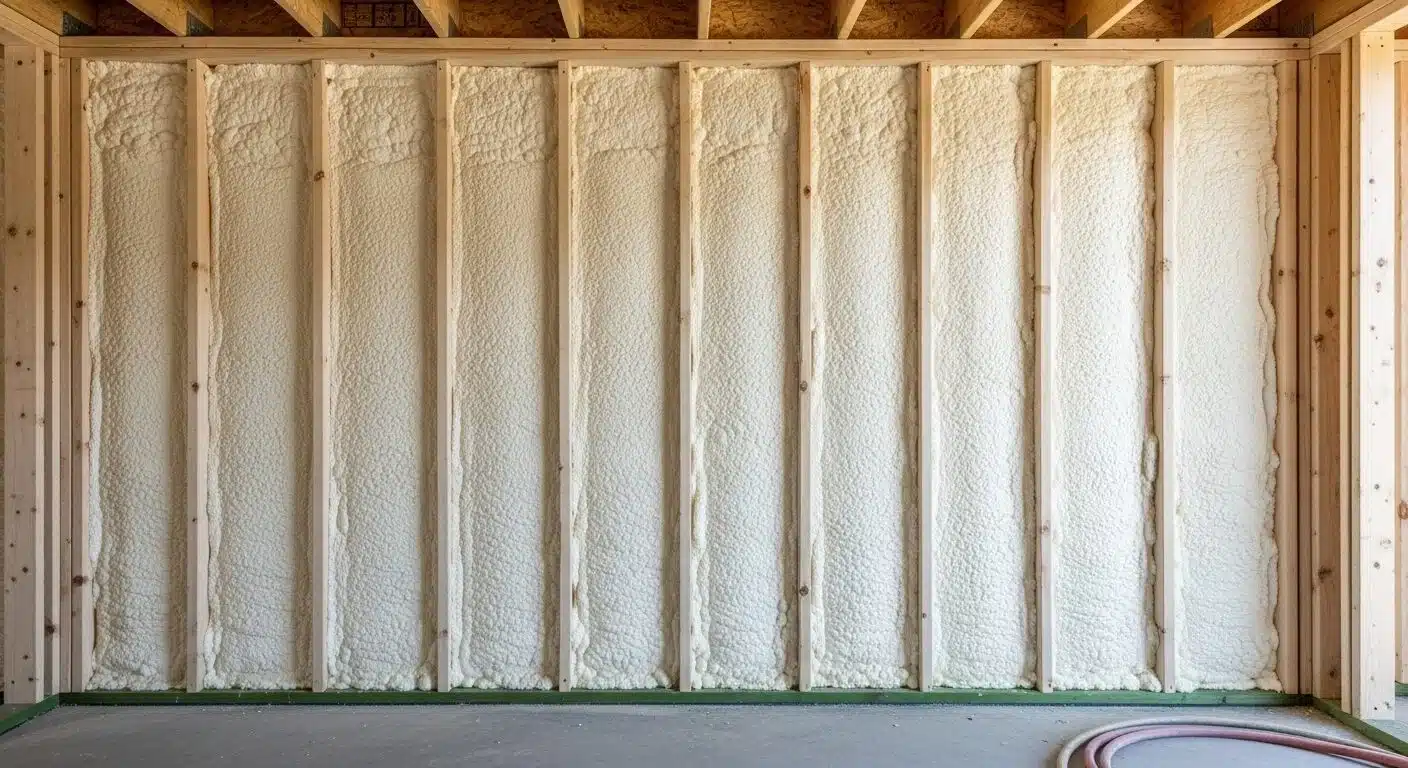
An insulated wall dramatically outperforms an uninsulated wall in nearly every measurable category. Depending on the insulation material and R-value, insulated walls reduce heat transfer by up to 95% compared to uninsulated assemblies, lower annual heating and cooling costs by 15% to 30%, and create noticeably more consistent indoor temperatures. According to the U.S. Department of Energy, adding insulation to under-insulated areas like walls, attics, and crawl spaces can save homeowners up to 20% on heating and cooling costs and up to 10% on total energy bills. For contractors and property owners, the difference is not incremental. It is the gap between a building that works and a building that wastes money every month.
TLDR / Key Takeaways
- Uninsulated walls typically achieve an effective R-value of R-2 to R-4 (framing only), while insulated walls reach R-13 to R-23 depending on material and thickness.
- The Department of Energy estimates that adding insulation to walls, attics, and basements can reduce heating and cooling costs by up to 20% and total energy costs by up to 10%.
- ENERGY STAR reports that proper air sealing combined with insulation saves an average of 15% on heating and cooling costs, or 11% on total energy costs.
- Wall insulation costs typically range from $1.50 to $4.50 per square foot installed, depending on material and wall accessibility.
- Spray foam insulation offers the highest R-value per inch (R-3.7 to R-6.5) while also sealing air leaks, making it the most effective single upgrade for existing walls.
- Uninsulated walls allow for 40% to 50% of a building’s conditioned air to escape through conduction, convection, and air infiltration combined.
- The payback period for adding wall insulation typically ranges from 3 to 7 years, depending on climate zone, energy rates, and insulation type.
What Actually Happens Inside an Uninsulated Wall
An uninsulated wall is essentially a thermal highway. Heat moves through it in three ways: conduction through solid framing members, convection through air gaps and cavities, and radiation across empty wall cavities. In a standard 2×4 wood-frame wall with no insulation, the effective R-value sits between R-2 and R-4, depending on cladding, sheathing, and drywall. That means almost no thermal resistance exists between the conditioned interior and the outdoor environment.
In summer, outdoor heat pours directly through the wall cavity into the living space, forcing HVAC systems to run harder and longer. In winter, the reverse happens: expensive heated air radiates outward through the walls continuously. The result is hot and cold spots throughout the building, excessive HVAC cycling, moisture condensation inside the wall cavity, and significantly higher energy bills.
An uninsulated wall also creates comfort problems that insulation entirely eliminates. Occupants near exterior walls feel drafts even when windows are closed, interior surface temperatures swing wildly throughout the day, and sound transmission between the outside and inside is noticeably worse.
How Insulation Changes the Equation
Insulation interrupts heat transfer by filling wall cavities with materials that resist thermal flow. The effectiveness of any insulation is measured by its R-value, which indicates thermal resistance per square foot per degree of temperature difference. Higher R-values mean better performance.
According to the Department of Energy, the overall R-value of a wall differs from the R-value of the insulation itself because heat flows more readily through studs than through the insulated cavities between them. This is called thermal bridging, and it is a real factor in every framed wall assembly. However, even with thermal bridging accounted for, an insulated wall still massively outperforms an uninsulated one.
R-Value Comparison by Insulation Type
| Insulation Material | R-Value Per Inch | Common Wall Thickness | Total Wall R-Value (Cavity Only) |
|---|---|---|---|
| Fiberglass batt (R-13) | 3.1 – 3.4 | 3.5″ (2×4 wall) | R-13 |
| Fiberglass batt (R-15) | 3.1 – 3.4 | 3.5″ (2×4 wall, high-density) | R-15 |
| Blown-in cellulose | 3.2 – 3.8 | 3.5″ (2×4 wall) | R-12 – R-15 |
| Open-cell spray foam | 3.5 – 3.7 | 3.5″ (2×4 wall) | R-12 – R-13 |
| Closed-cell spray foam | 5.6 – 6.5 | 3.5″ (2×4 wall) | R-19 – R-23 |
| None (uninsulated) | 0 | N/A | R-2 – R-4 (framing only) |
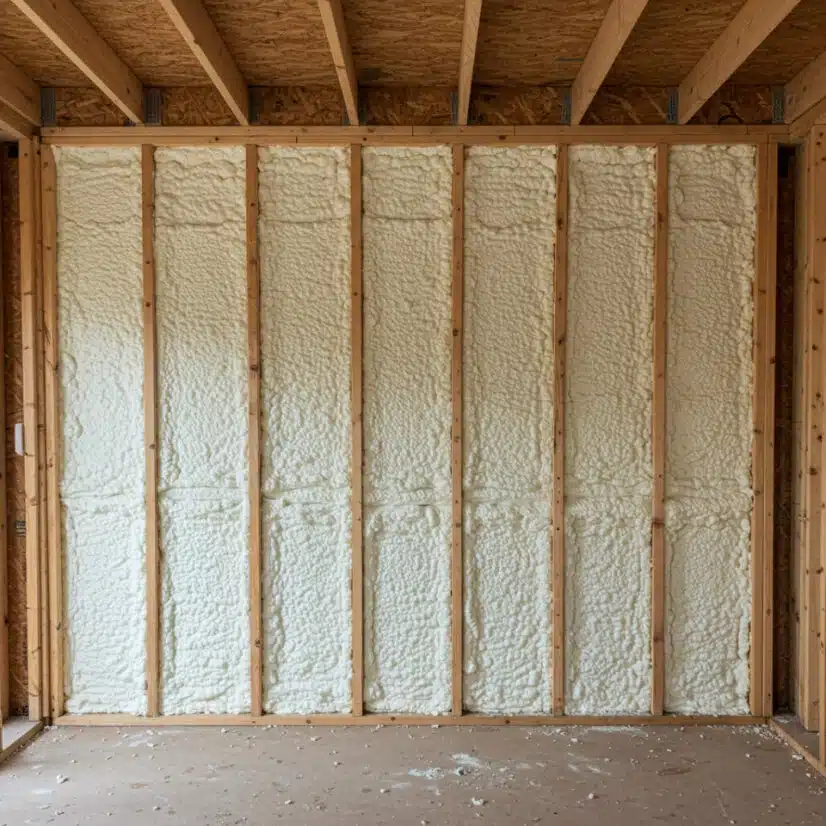
A closed-cell spray foam application in a standard 2×4 wall cavity can achieve an R-value nearly six times higher than the same wall left uninsulated. That difference directly translates to energy savings, comfort improvement, and building durability.
The Real Dollar Difference: Insulated vs Uninsulated Walls
Numbers make the case clearer than anything else. Consider a 2,000 square foot single-story home in a mixed-humid climate zone with approximately 1,600 square feet of exterior wall area. The table below estimates annual energy cost differences based on typical heating and cooling loads.
| Metric | Uninsulated Walls | Insulated Walls (R-13 Batt) | Insulated Walls (R-21 Spray Foam) |
|---|---|---|---|
| Estimated Annual HVAC Cost | $3,200 | $2,560 | $2,240 |
| Annual Savings vs Uninsulated | Baseline | $640 (20%) | $960 (30%) |
| 10-Year HVAC Savings | $0 | $6,400 | $9,600 |
| Estimated Installation Cost | $0 | $2,400 – $4,800 | $4,800 – $7,200 |
| Approximate Payback Period | N/A | 4 – 7 years | 5 – 7.5 years |
These figures align closely with the Insulation Institute, which has documented that upgrading insulation to meet modern energy codes delivers a strong return on investment, often paying for itself within several years through energy savings alone. The savings grow even more favorable when factoring in federal tax credits of up to $1,200 for qualifying insulation improvements under the Inflation Reduction Act.
Beyond Energy Savings: Performance Gains That Matter
Energy cost reduction gets most of the attention, but the advantages of insulated walls extend well beyond utility bills.
Moisture control and building durability. When warm, humid indoor air meets a cold wall surface in winter, condensation forms inside the cavity. Over time, this moisture leads to mold growth, wood rot, and structural damage. Insulation keeps wall cavity surfaces closer to indoor temperatures, dramatically reducing the risk of condensation. Spray foam insulation goes a step further by acting as a vapor barrier in addition to a thermal barrier.
Sound transmission. An uninsulated wall has minimal ability to block sound. Adding fiberglass batts improves sound transmission class (STC) ratings by approximately 4 to 6 points, while dense-pack cellulose or spray foam can improve STC ratings by 5 to 8 points. For buildings near busy roads, commercial districts, or multi-family properties, this acoustic benefit has real functional value.
HVAC equipment lifespan. When a building loses large amounts of conditioned air through uninsulated walls, the HVAC system runs longer cycles and more frequently to maintain set temperatures. This added workload shortens equipment lifespan and increases maintenance costs. Insulated walls reduce HVAC run times, which extends the life of compressors, fans, and heat exchangers.
Indoor comfort and consistency. Occupants consistently report higher satisfaction in insulated buildings. Surface temperatures on interior walls stay within 2 to 3 degrees of the room air temperature when walls are properly insulated, compared to swings of 10 to 15 degrees in uninsulated assemblies. This eliminates the cold-wall effect that makes people feel chilly even when the thermostat reads 72 degrees.
Real-World Contractor Scenarios
| Scenario | Property Type | Recommended Option | Estimated Cost |
|---|---|---|---|
| Open wall cavities during full gut renovation | 1960s single-family home, 1,800 sq ft | Closed-cell spray foam in all exterior walls | $6,300 – $9,000 |
| Finished walls, no demolition budget | 1990s stucco home, 2,400 sq ft | Dense-pack cellulose blown through small holes | $3,600 – $5,400 |
| New construction, mixed-humid climate | Custom build, 2,200 sq ft | Open-cell spray foam with rigid foam sheathing | $5,500 – $8,000 |
| Commercial office, steel stud walls | Strip mall tenant space, 3,000 sq ft | Fiberglass batts with rigid continuous insulation | $4,200 – $6,000 |
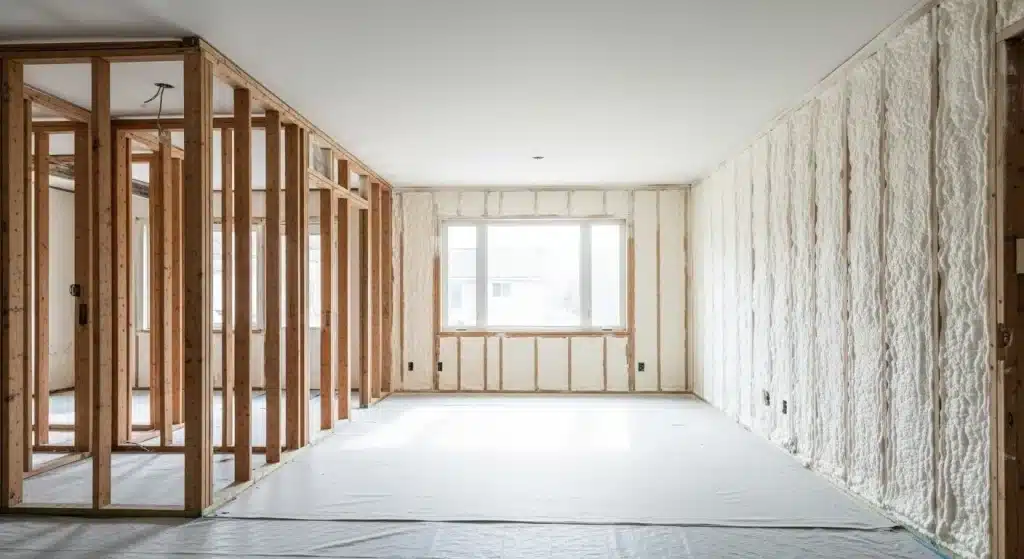
| Garage conversion to living space | Detached garage, 600 sq ft | Closed-cell spray foam (moisture + thermal) | $2,100 – $3,600 |
Factors That Influence the Decision
Several variables determine how much benefit wall insulation delivers and which material makes the most sense for a given project.
- Climate zone: Buildings in extreme cold (zones 5 through 7) see the largest percentage savings from wall insulation. In mild climates (zones 1 through 3), the savings are smaller but still meaningful for comfort and moisture control.
- Existing wall assembly: 2×4 walls limit cavity depth to 3.5 inches, which caps how much insulation fits. 2×6 walls allow 5.5 inches of cavity fill, achieving higher total R-values without upgrading materials.
- Wall accessibility: Open walls during renovation allow for direct application of any insulation type. Finished walls require blown-in materials or injection foam, which have different performance characteristics and costs.
- HVAC system efficiency: Newer, high-efficiency HVAC systems magnify the value of insulation because every unit of heat retained or blocked costs less to produce. Older, less efficient systems benefit, but the percentage savings may appear smaller.
- Budget and timeline: Fiberglass batts offer the lowest upfront cost. Spray foam delivers the best overall performance but comes at a premium. Blown-in cellulose and injection foam fall between the two on both cost and performance.
- Building code requirements: Many jurisdictions now require minimum wall R-values for new construction and significant renovations. Failing to insulate to code can stop a project in its tracks during inspection.
Who This Is For / Who This Is NOT For
Insulated walls are ideal for:
- New construction projects where wall cavities are open and accessible
- Full gut renovations where drywall is already being removed
- Older homes with zero wall insulation and high energy bills
- Buildings in climate zones 4 through 7, where heating and cooling loads are significant
- Properties where moisture control, soundproofing, and indoor air quality are priorities
Insulated walls may not be the right priority for:
- Buildings with rigid exterior continuous insulation already installed (the cavity may be less critical)
- Extremely tight budgets, where other building envelope improvements like air sealing would deliver faster returns
- Temporary structures or short-tenant-lease commercial spaces where the payback period exceeds the occupancy timeline
- Historic buildings with rigid preservation requirements limiting wall cavity modifications
Get an Expert Assessment for Your Next Project
Every building is different, and the right insulation strategy depends on wall construction, climate zone, budget, and project scope. Our team at Supreme Spray Foam LV brings years of hands-on experience to residential and commercial insulation projects across the Las Vegas area. We evaluate your specific wall assemblies, recommend the most cost-effective materials, and deliver installations that perform for decades. Reach out to us at [email protected] or call (702) 904-9895 to discuss your project.
FAQs
Can I add insulation to walls without removing drywall?
Yes, several methods allow wall insulation retrofits without drywall demolition. Dense-pack cellulose can be blown into wall cavities through small holes drilled through the exterior or interior. Injection foam products are also designed for installation through small access points. Both methods effectively fill existing cavities, though they typically achieve slightly lower R-values than open-cavity spray foam applications.
Is spray foam insulation worth the extra cost over fiberglass?
For most wall applications, spray foam delivers measurably better performance than fiberglass in two key areas: higher R-value per inch and air sealing. Closed-cell spray foam also adds structural rigidity and acts as a vapor barrier. The premium over fiberglass typically ranges from 30% to 60%, but the improved air sealing alone can account for a significant portion of overall energy savings, making it a strong value for moisture-prone or extreme-temperature environments.
How do I know if my walls are already insulated?
The most reliable method is a thermal imaging scan, which reveals temperature differences across wall surfaces that indicate missing or settled insulation. A visual inspection through electrical outlet boxes (with power turned off) can also reveal whether cavity fill exists. Homes built before the 1970s are the most likely to have uninsulated walls, while homes built after 1990 typically have at least R-11 to R-13 fiberglass batts in wall cavities Green Building Advisor.
Does wall insulation help in hot climates like Las Vegas?
Absolutely. In hot climates, wall insulation prevents outdoor heat from conducting into the conditioned interior, which is the primary driver of cooling loads. A well-insulated wall keeps interior surfaces cooler, reduces HVAC run times during peak summer months, and improves comfort by eliminating the radiant heat effect from sun-exposed walls. The benefit is especially pronounced on west-facing and south-facing walls that receive the most direct solar exposure.
What R-value should exterior walls have?
The Department of Energy recommends minimum wall cavity R-values ranging from R-13 to R-23 depending on climate zone. In climate zones 1 through 3 (including Las Vegas in zone 3), the minimum recommended cavity insulation is R-13 for 2×4 walls or R-19 to R-20 for 2×6 walls. In colder zones 4 through 7, R-20 to R-23 cavity insulation is recommended, often supplemented with continuous rigid insulation on the exterior sheathing for maximum thermal performance.
Sources
- U.S. Department of Energy – Guide to Home Insulation – Comprehensive guide covering insulation types, R-values, and estimated savings of up to 20% on heating and cooling costs.
- U.S. Department of Energy – Insulation – Overview of insulation fundamentals, R-value recommendations by climate zone, and thermal bridging effects in wall assemblies.
- ENERGY STAR – Methodology for Estimated Energy Savings – EPA estimates that air sealing combined with insulation saves an average of 15% on heating and cooling costs.
- Insulation Institute – Infographic Shows ROI for Modern Energy Codes – Data on the cost of meeting 2021 IECC energy codes and the return on investment for insulation upgrades in single-family homes.
- Green Building Advisor – Energy Simulations Comparing Wall R-Values – Detailed discussion of how incremental R-value increases in wall assemblies affect total building energy performance.