
For most Las Vegas properties, closed cell spray foam is the better overall choice due to its higher R-value per inch (R-6 to R-7), superior moisture barrier, and structural reinforcement, all of which matter in a desert climate where summer temperatures routinely exceed 110°F. However, open cell spray foam has specific advantages in interior wall cavities and sound control applications where its lower cost and expansive coverage make it a practical option. The right choice comes down to where you are insulating, your budget, and whether the project requires a vapor barrier.
TLDR / Key Takeaways
- Closed cell spray foam delivers R-6 to R-7 per inch compared to open cell’s R-3.6 to R-3.8 per inch, giving it roughly double the thermal resistance in the same thickness.
- Las Vegas sits in Climate Zone 3, where the Department of Energy recommends R-38 to R-49 for attics and R-13 for walls.
- Closed cell foam costs roughly $1.00 to $1.50 per board foot, while open cell runs $0.35 to $0.65 per board foot, making open cell significantly more budget-friendly.
- Closed cell spray foam acts as a vapor barrier and air sealant in one, which is critical during the Las Vegas monsoon season when humidity spikes.
- Open cell expands up to 100 times its volume, filling irregular cavities more effectively, but it does not block moisture vapor.
- Closed cell adds structural rigidity to walls and roof decks, open cell does not.
- For most exterior applications in Las Vegas, closed cell is the recommended choice. Open cell works best for interior sound walls and large, hard-to-reach cavities.
How Las Vegas Climate Demands More From Insulation
Las Vegas is not a typical climate. With summer highs consistently above 100°F and a desert environment that swings 30 to 40 degrees between day and night, insulation here does double duty. It blocks extreme daytime heat gain and helps retain conditioned air during cooling months that stretch from April through October.
The city falls within ASHRAE Climate Zone 3B, which is classified as warm-dry. This zone requires insulation that performs well against heat transfer rather than cold. According to ENERGY STAR’s recommended home insulation R-values, attics in Climate Zone 3 should reach R-38 to R-49, and walls should achieve at least R-13 to R-20, depending on construction type.
When temperatures hit 115°F outside, the difference between R-3.8 per inch (open cell) and R-7 per inch (closed cell) becomes the difference between a comfortable interior and an AC system working overtime. That gap in thermal performance compounds across thousands of square feet of exterior surface area.
Head-to-Head: Open Cell vs. Closed Cell Spray Foam
| Feature | Open Cell Spray Foam | Closed Cell Spray Foam |
|---|---|---|
| R-Value Per Inch | R-3.6 to R-3.8 | R-6.0 to R-7.0 |
| Density | 0.5 to 1.5 lbs/ft³ | 1.7 to 2.5 lbs/ft³ |
| Expansion Rate | Up to 100x its volume | 30 to 40x its volume |
| Vapor Barrier | No (vapor permeable) | Yes (Class II vapor retarder) |
| Air Barrier | Yes | Yes |
| Structural Support | No | Yes, adds rigidity |
| Sound Damping | Excellent | Moderate |
| Cost Per Board Foot | $0.35 to $0.65 | $1.00 to $1.50 |
| Best Application | Interior walls, sound isolation | Exterior walls, roofs, attics, crawlspaces |
Where Closed Cell Spray Foam Wins in Las Vegas
Superior Heat Resistance for Extreme Temperatures
Closed cell spray foam delivers roughly double the R-value per inch compared to open cell. When Johns Manville compares the two products, they highlight that closed cell’s R-7 per inch means you achieve the same thermal resistance in half the thickness. In a Las Vegas attic where space is limited by roof pitch, achieving R-38 with open cell would require roughly 10 inches of material. Closed cell can hit that same target in about 5.5 inches.
Moisture Control During Monsoon Season
Las Vegas summers include a brief but intense monsoon season from July through September. Humidity can spike from single digits to over 60%, and sudden rainstorms dump water on properties not built for heavy moisture UpCodes . Closed cell spray foam acts as a vapor retarder, preventing moisture from infiltrating wall cavities and roof assemblies where it can cause mold, rot, and structural damage. Open cell is vapor permeable, meaning moisture passes right through it and into your building envelope.
Structural Reinforcement
Closed cell foam’s higher density makes it rigid once cured. It bonds to framing and sheathing, adding shear strength to wall assemblies. For older Las Vegas homes built with lighter framing or for commercial steel buildings that flex under high wind loads, this structural benefit is meaningful. Open cell remains soft and spongy and provides no structural value.
Where Open Cell Spray Foam Makes Sense
Cost-Effective Interior Applications
If the project budget is tight and you are insulating interior partition walls, open cell spray foam offers strong air sealing at a fraction of closed cell’s cost. At $0.35 to $0.65 per board foot versus $1.00 to $1.50 for closed cell, open cell can cover significantly more area for the same investment. For a contractor building spec homes or managing a multi-unit renovation where wall cavities are deep enough to accommodate the extra thickness, open cell is a smart financial decision.
Sound Isolation Between Rooms
Open cell’s lower density and open cell structure make it one of the best sound-damping insulation products available. For hotel rooms, apartment complexes, home theaters, or office partitions in Las Vegas commercial buildings, open cell spray foam reduces airborne noise transmission more effectively than closed cell. This acoustic benefit alone can justify choosing open cell for interior applications.
Filling Irregular Cavities
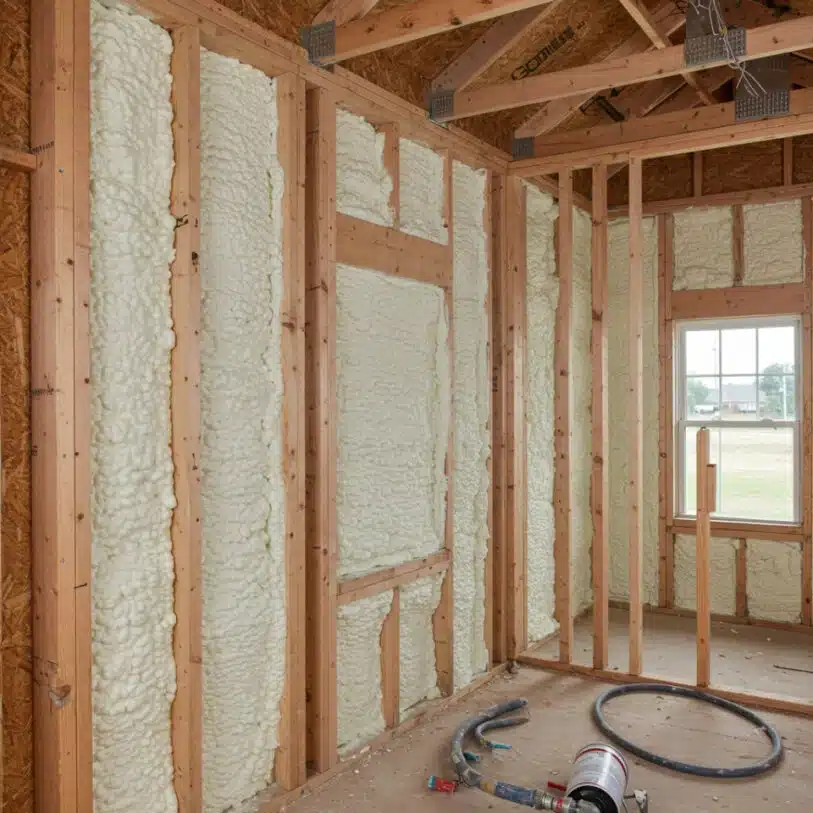
Open cell expands more dramatically than closed cell, sometimes reaching 100 times its original volume. This makes it effective for filling complex framing bays, cathedral ceiling assemblies, and tight spaces where closed cell may not reach every corner. In remodels where wall cavities are partially obstructed by plumbing or electrical runs, open cell’s expansive nature ensures complete coverage.
Cost Comparison for a Typical Las Vegas Project
| Project Area | Square Footage | Open Cell (Est.) | Closed Cell (Est.) |
|---|---|---|---|
| Attic (1,500 sq ft) | 1,500 sq ft | $1,500 to $2,800 | $3,000 to $5,250 |
| Exterior Walls (2,000 sq ft) | 2,000 sq ft | $2,000 to $3,700 | $4,000 to $7,000 |
| Interior Sound Walls (800 sq ft) | 800 sq ft | $700 to $1,200 | Not recommended |
| Crawl Space (1,000 sq ft) | 1,000 sq ft | Not recommended | $1,800 to $3,000 |
Estimates assume standard 2×4 or 2×6 framing cavities. Actual costs vary based on thickness, accessibility, and site conditions.
Real-World Scenarios for Las Vegas Properties
| Scenario | Property Type | Recommended Option | Why |
|---|---|---|---|
| Summerlin new construction, 2,500 sq ft home | Single-family residence | Closed cell for exterior walls and attic | Maximum R-value in limited cavity space, vapor protection, and structural support |
| Downtown Las Vegas hotel renovation | Commercial hospitality | Open cell for interior partition walls | Superior sound isolation between guest rooms at a lower cost |
| North Las Vegas warehouse retrofit | Commercial/industrial | Closed cell for roof deck and walls | High R-value per inch, air sealing for HVAC efficiency, moisture barrier |
| Henderson spec home build | Single-family residence | Open cell for walls, closed cell for attic only | Budget-conscious approach that still protects against desert heat gain |
| Southwest Las Vegas metal building shop | Commercial / storage | Closed cell for roof and walls | Moisture barrier, condensation control, and structural rigidity for steel framing |
Factors That Influence the Decision
- Climate zone requirements: Las Vegas requires R-38 to R-49 in attics. Achieving this with open cell alone may not be practical in shallow cavities.
- Budget: Closed cell can cost 2 to 3 times more per board foot than open cell, which affects total project spend significantly.
- Cavity depth: Standard 2×4 walls (3.5-inch cavity) limit total R-value. Closed cell achieves R-21 to R-24.5 in that space, while open cell only reaches R-12.6 to R-13.3.
- Moisture exposure: Areas prone to monsoon-driven humidity or roof leaks benefit from closed cell’s vapor barrier properties.
- Sound control needs: If noise isolation between spaces is a priority, open cell outperforms closed cell in acoustic damping.
- Structural requirements: For older homes, light-frame construction, or steel buildings, closed cell adds measurable shear strength.
- HVAC ductwork location: When ducts run through unconditioned attic space, closed cell insulation below the roof deck creates a conditioned attic and reduces duct heat gain dramatically.
Who Closed Cell Spray Foam Is For (and Who It Is NOT For)
Closed cell spray foam is ideal for:
- Exterior walls and attics in new Las Vegas construction
- Roof decks and cathedral ceilings with limited cavity depth
- Crawlspaces and basements where moisture intrusion is a concern
- Metal buildings and commercial properties need structural reinforcement
- Property owners prioritizing long-term energy savings over upfront cost
Closed cell spray foam is NOT ideal for:
- Interior partition walls where sound isolation is the primary goal
- Tight-budget projects where maximizing coverage area matters more than peak R-value
- Deep cavities where less expensive insulation types can achieve code-required R-values
- Applications where flexibility and movement in the building envelope are needed
Who Open Cell Spray Foam Is For (and Who It Is NOT For)
Open cell spray foam is ideal for:
- Interior walls requiring sound dampening between rooms or units
- Large, irregular cavities that benefit from its high expansion rate
- Budget-conscious projects that still need air sealing
- New construction where cavity depth allows sufficient total R-value
Open cell spray foam is NOT ideal for:
- Exterior walls exposed to monsoon moisture and extreme heat
- Thin cavities where R-13 or higher cannot be achieved
- Roof assemblies and attics in Las Vegas, where maximum thermal resistance is non-negotiable
- Crawlspaces, basements, or any area with moisture exposure
Ready to Insulate Your Las Vegas Property the Right Way?
Choosing between open cell and closed cell spray foam in Las Vegas comes down to matching the right product to the right application, climate demands, and budget. We have insulated hundreds of homes and commercial properties across the Las Vegas Valley and can recommend the approach that maximizes your energy savings without overpaying for performance you do not need.
Get in touch with our team at Supreme Spray Foam LV by calling (702) 904-9895 or emailing [email protected] to discuss your project. We provide honest assessments and detailed quotes tailored to your specific property and goals.
FAQs
Can I use both open cell and closed cell spray foam on the same project?
Yes, and many contractors do. A common approach in Las Vegas is closed cell foam on exterior walls and the attic for maximum thermal resistance and moisture protection, paired with open cell foam on interior partition walls for sound control. This hybrid strategy gets you the best of both products while managing overall project cost.
Is spray foam insulation worth the cost in Las Vegas?
In a climate where air conditioning runs for six to seven months straight, the air sealing and high R-value of spray foam insulation can reduce cooling costs by 20% to 50%, depending on the existing insulation and construction quality. The upfront investment pays back over time through lower utility bills and improved indoor comfort.
How long does spray foam insulation last in a desert climate?
Properly installed spray foam insulation can last the lifetime of the building. Unlike fiberglass batts that sag, settle, or absorb moisture over time, spray foam adheres to framing and maintains its R-value and air sealing properties for decades, even under extreme desert heat.
Does closed cell spray foam prevent roof leaks?
Closed cell spray foam is not a roofing material, but it can temporarily slow water infiltration and prevent moisture from spreading into the building envelope. If a roof leak develops, the foam beneath it may delay water damage but will not stop it permanently. Any roof leak should be repaired by a qualified roofing contractor regardless of insulation type.
What R-value should I target for my Las Vegas attic?
The Insulation Institute recommends R-38 to R-49 for attics in Climate Zone 3 (Las Vegas). Closed cell spray foam achieves this in approximately 5.5 to 7 inches of thickness, while open cell would require 10 to 14 inches. If your attic has limited space, closed cell is the more practical option for reaching the recommended R-value.
Sources
- ENERGY STAR – Recommended Home Insulation R-Values – Official R-value recommendations by climate zone for residential construction.
- Johns Manville – Spray Foam: Open-Cell vs. Closed-Cell – Technical comparison of open cell and closed cell spray foam including R-values, density, and application guidance.
- UpCodes – Las Vegas Residential Energy Efficiency Code – Local building code requirements for minimum insulation R-values in Las Vegas residential construction.
- Insulation Institute – IECC Compliance Guide for Homes in Nevada – Nevada-specific insulation code compliance requirements and R-value minimums.
- U.S. Department of Energy – Energy-Efficient Home Improvement Credit – Federal guidance on insulation R-value thresholds for energy code compliance.