
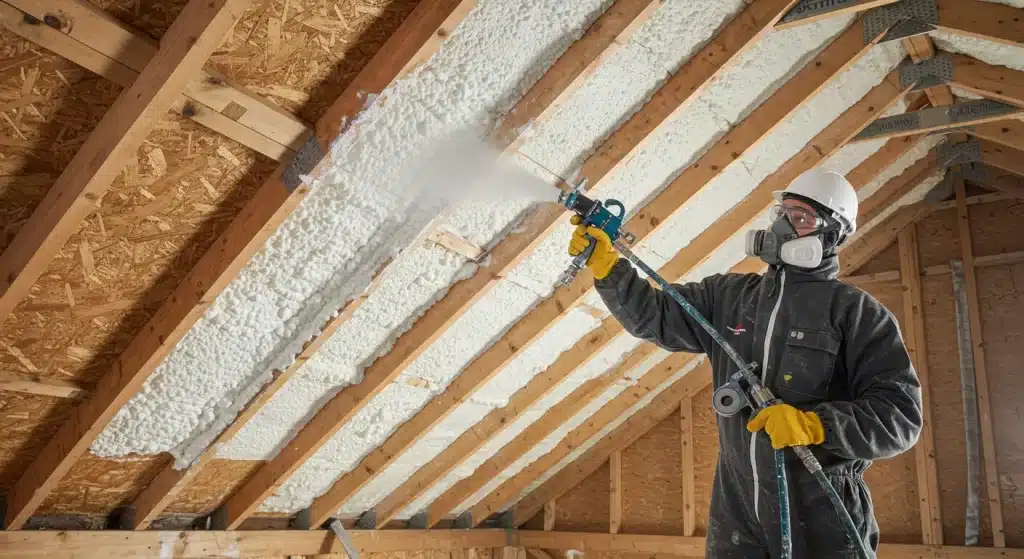
Spray foam insulation reduces noise by sealing gaps and limiting air movement, which prevents sound waves from easily passing through walls, ceilings, and floors. Both open cell and closed cell spray foam provide sound dampening benefits, though open cell foam is more effective for airborne noise like voices and television sounds. Closed cell foam primarily controls vibration and impact noise due to its denser structure.
Spray foam is not a complete soundproofing solution, but it improves acoustic comfort significantly in residential and commercial buildings. This article outlines how spray foam works, compares its performance against other insulation types, and presents practical insights from real-world applications.
How Spray Foam Insulation Reduces Noise
Spray foam insulation reduces airborne sound transmission by filling cavities and sealing leaks where sound would otherwise pass through. In practice, this helps limit common disturbances such as outside traffic, noisy neighbors, or equipment noise inside commercial spaces.
Technical data on sound control
*STC = Sound Transmission Class (higher values indicate better sound blocking)
Regional Considerations
In Nevada and other desert climates, open cell foam can be applied in attics and walls to reduce street noise and indoor echo, while closed cell foam is useful where structural reinforcement and vibration control are priorities. The dry climate reduces concerns about moisture absorption, but energy efficiency and noise control remain significant benefits.
Bonus Tip: For homes near busy streets or airports, combining open cell foam with drywall layers provides measurable improvements in reducing disruptive sound.
Things to Review Before Selecting Spray Foam for Noise Control
- Type of Noise: Identify whether airborne sound (voices, music) or impact sound (footsteps, machinery vibration) is the main issue.
- Building Use: Commercial buildings with equipment benefit from closed cell foam; residential living spaces often benefit from open cell foam.
- Long-Term Goals: Consider whether the insulation needs to provide additional benefits such as moisture resistance or structural support.
- Installation Area: Attics and walls often require open cell foam; basements, roofing, and exterior walls often use closed cell foam.
Bonus Tip: Combining spray foam with acoustic panels or soundproof drywall achieves stronger overall noise reduction.
Services Directly Related to Noise Reduction
- Wall Insulation: Helps reduce sound transfer between rooms and from outside sources.
- Attic Insulation: Limits external noise infiltration from rooftops and air gaps.
- Closed Cell Spray Foam Insulation: Adds density for controlling vibration and low-frequency noise.
- Open Cell Spray Foam Insulation: Absorbs airborne noise effectively in living areas.
Does spray foam completely block noise?
No, it reduces noise but does not achieve full soundproofing.
Which type of spray foam works best for sound?
Open cell for airborne noise, closed cell for vibration and impact noise.
Can spray foam be combined with other soundproofing materials?
Yes, layering drywall or using acoustic panels increases performance.
How long does spray foam last for noise reduction?
Both open and closed cell foam typically last several decades without losing sound dampening ability.
Key Takeaways
Spray foam insulation improves acoustic comfort by limiting both airborne and impact noise. Open cell spray foam is more effective for everyday household sounds, while closed cell spray foam addresses vibration and structure-borne noise. For Nevada buildings, spray foam provides both sound control and energy efficiency benefits.
Contact Supreme Spray Foam LV
For more information about insulation options for noise control, contact Supreme Spray Foam LV at info@supremesprayfoamlv.com or call (702) 904-9895. A specialist can review your building’s structure and advise on the best application for long-term performance.
How does spray foam compare with soundproof drywall?
Soundproof drywall has higher STC ratings, but spray foam adds both noise reduction and thermal insulation.
Does spray foam settle or lose effectiveness over time?
No, once cured it remains stable for decades.
Can spray foam reduce noise in existing walls without major renovation?
Retrofitting is possible by drilling small access holes and injecting foam, though performance is lower than in new construction.
Is spray foam effective against low-frequency sounds like bass music?
Closed cell foam helps reduce vibration but may not fully block deep bass tones.
Can spray foam help in multi-family housing units?
Yes, it reduces sound transfer between shared walls and floors, improving acoustic comfort.