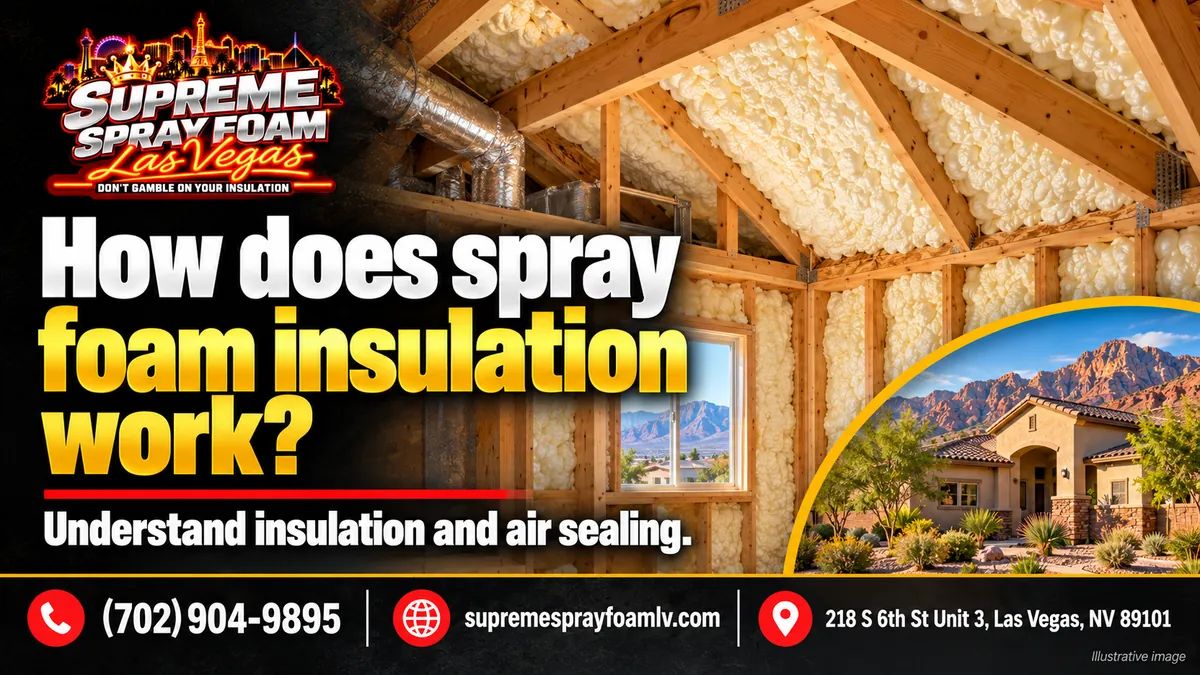
Spray foam insulation starts as a liquid mixture that expands and cures into an insulating material. When installed at the specified thickness and connected to the surrounding air barrier, the right product can slow heat transfer and reduce unwanted air leakage. For a Las Vegas home, these are separate but related ways to help control the cooling load.
What happens when spray foam is applied
In many professional installations, two liquid components meet at the application equipment and react to form polyurethane foam. Expansion helps the material conform to the surface and fill accessible spaces. The installer must follow the product instructions for surface conditions, application layers, and curing.
The important result is the finished installation, not how dramatic the expansion looks. A thick patch in one place does not compensate for an uncovered gap nearby. The EPA overview of spray foam product types also distinguishes large professional systems from smaller foam sealants. A can used around a small opening is not a plan for insulating an entire attic.
How insulation slows heat transfer
Heat moves from warmer areas toward cooler areas. Insulation adds resistance to that movement through the parts of a building where it is installed. On a hot afternoon, a well-designed roof or wall assembly can reduce how quickly outdoor heat reaches conditioned rooms. In cooler weather, the same assembly helps slow heat leaving those rooms.
R-value describes resistance to heat flow. The product, installed thickness, and coverage quality matter. Framing and other paths through the assembly still affect its overall performance. The Department of Energy explanation of insulation is a useful starting point for understanding the material’s role.
How air sealing differs from insulation
Air leakage carries outdoor air through gaps in the building enclosure. That is different from heat moving through a solid surface. Spray foam can contribute to both insulation and air sealing, but only when the product is suitable for that use and the installation meets its documented requirements.
Imagine a wall cavity filled with foam while an adjacent service penetration remains open. The cavity may be insulated, but the opening still needs attention. Ask how the proposed work connects to the air barrier at edges, penetrations, and adjoining surfaces. DOE’s air sealing guidance explains why insulation and sealing are assessed together.
For an audio companion to this guide, listen to the spray foam episode on Podbean.
Where the insulation belongs in your home
Start by identifying the boundary around the space you actually heat or cool. In one home, that boundary may be at the attic floor. In another, a properly designed unvented attic may place it at the roofline. These are different assemblies, with different moisture, ventilation, and equipment considerations.
Do not assume that every attic should have foam applied underneath the roof. If the concern is an attic, explore attic insulation with the existing roof and ventilation arrangement in mind. If exterior walls are involved, the wall insulation service can help frame a discussion about access, existing finishes, and the proposed work.
Why open cell and closed cell are different
Open-cell foam is generally softer and lower in density. Closed-cell foam is generally more rigid and provides higher thermal resistance per inch. Their vapor behavior also differs. Those distinctions influence where each product may fit, but the product data and assembly design must determine the final choice.
Supreme Spray Foam LV lists both open-cell spray foam and closed-cell spray foam services. Ask which is proposed for your project and why. A claim that one type is always right for every Las Vegas building skips the assessment that matters.
For a closer comparison of these options, read our guide to the difference between open-cell and closed-cell spray foam.
What to check before installation
A useful written scope identifies the surfaces, preparation, chosen product, insulation target, and protective covering required for the location. It should explain how coverage and adhesion will be checked, what happens to unsuitable existing material, and which finishes or services are excluded.
Ask who will address existing roof leaks, wet materials, or damaged framing before insulation goes in. Also discuss ventilation and any combustion equipment affected by changes to the enclosure. Concealing a problem behind new insulation does not solve its cause.
You can also listen to our How Does Spray Foam Work audio on SoundCloud while reviewing the installation questions for your property.
What occupants should expect during the work
Spray foam application requires controls to protect workers and occupants. Discuss isolation of the work area, ventilation, belongings that must be moved, and instructions for people and pets. Obtain the product-specific reentry and reoccupancy guidance before the installation date.
The EPA spray foam safety information describes exposure concerns during and after application. There is no universal waiting period that applies to every product and every job. Foam that looks finished is not, by itself, proof that a room is ready to occupy.
Discuss your Las Vegas insulation project
Describe the rooms that feel uncomfortable, the time of day the problem occurs, and any changes already made to the home. Supreme Spray Foam LV serves Las Vegas, Paradise, Henderson, and Spring Valley. Its residential spray foam insulation service provides a place to start that conversation.
Request an insulation assessment or call (702) 904-9895. Ask for an explanation of the proposed assembly and the expected benefit for your property before choosing a product.
Find Supreme Spray Foam LV
218 S 6th St Unit 3, Las Vegas, NV 89101. Contact the business before visiting.