
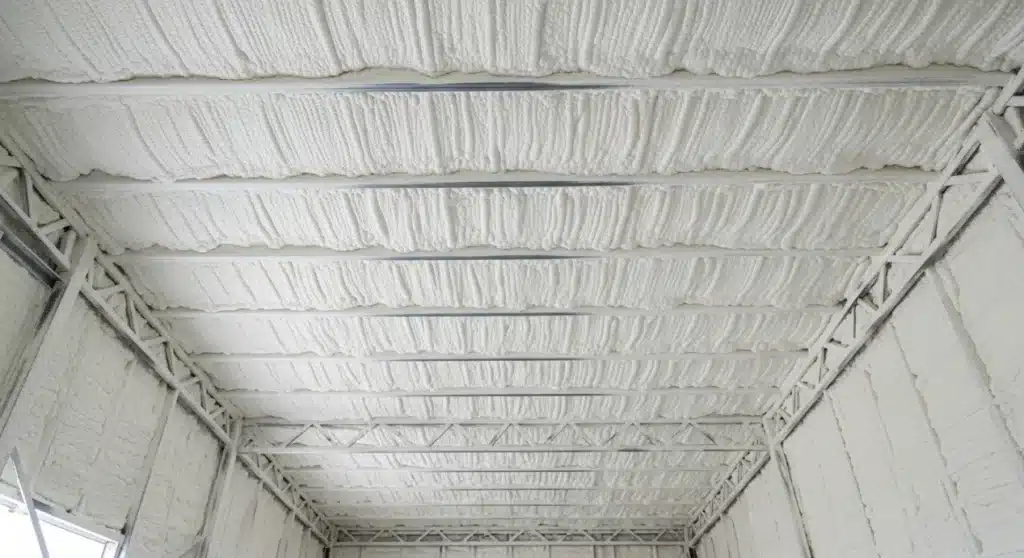
Office noise is more than just a minor annoyance; it directly impacts concentration, productivity, and employee well-being. In a bustling environment like Las Vegas, spray foam insulation offers a powerful solution by creating a complete air seal that blocks airborne sound, absorbing sound waves, and damping vibrations. This guide breaks down the six specific mechanisms by which spray foam quiets a busy office, helping business owners and facility managers make informed decisions about sound control.
How Spray Foam Insulation Controls Sound
Spray foam insulation manages sound through several physical properties. Its effectiveness comes from its ability to be applied as a liquid that expands, creating a custom-fit barrier perfectly molded to the structure.
1. Creating an Airtight Seal to Block Sound
Sound travels through the air. Any crack, gap, or seam in a wall or ceiling is a potential pathway for noise to enter a room. Traditional insulation, like batts or rolls, can leave small gaps around outlets, pipes, and framing. Spray foam expands up to 100 times its initial volume, filling every one of these imperfections to create a monolithic, airtight barrier. A report from the U.S. Department of Energy explains that air barriers are essential for stopping this type of sound transmission. By eliminating air movement through the building envelope, spray foam effectively blocks a primary route for airborne noise.
2. Damping Vibrations in Walls and Floors
Sound also travels as vibrations through solid materials like wood studs, drywall, and floor joists. This is known as structure-borne noise. When spray foam is applied, it adheres tightly to these building components. Once cured, its rigid structure acts as a damper, absorbing vibrational energy and stopping it from moving through the assembly. This is especially effective at reducing low-frequency sounds, like the rumble of traffic or the hum of machinery, which are often the most difficult to control.
3. Absorbing Sound with Open-Cell Foam
Different types of spray foam offer different acoustic benefits. Open-cell spray foam has a softer, more flexible consistency with tiny, interconnected air pockets. This structure is excellent at absorbing sound waves, particularly in the mid-to-high frequency range, which includes human speech. When sound waves hit the foam, they become trapped within these cells, and their energy is converted into a minuscule amount of heat. According to data from Intertek, an independent testing laboratory, open-cell spray foam can achieve a high Noise Reduction Coefficient (NRC), a measure of how well a material absorbs sound.
4. Preventing Flanking Noise
Flanking is the term for sound that finds an indirect path around or through a soundproofed wall. It can travel through floor joists, ceiling plenums, HVAC ductwork, and electrical conduits. Because spray foam insulation is applied as a liquid, it can completely encapsulate these potential flanking paths. By sealing around pipes, ducts, and joists, it closes off these “back doors” for sound, ensuring the acoustic integrity of the entire room assembly.
To understand their different acoustic roles, it’s helpful to compare the two main types of spray foam directly.
Sound Reduction Properties: Open-Cell vs. Closed-Cell Foam
Bonus Tip: For conference rooms or private offices where confidentiality is key, using open-cell foam in the interior walls is highly effective. Its sound-absorbing qualities are ideal for muffling conversations and preventing them from being overheard in adjacent spaces.
5. Minimizing Impact Noise Between Floors
Impact noise, like footsteps from an upper floor, a dropped object, or a rolling office chair, is a common complaint in multi-level buildings. Applying spray foam insulation in the floor-ceiling assembly can significantly reduce this type of disturbance. The foam’s mass and damping properties help absorb the energy generated by the impact before it can radiate as sound into the room below. While not a complete solution on its own, it contributes to a much quieter environment when used with other sound-dampening materials.
6. Quieting HVAC Systems
The sound of air rushing through ducts and the rattling of the metal components can be a constant source of background noise. In a climate like Las Vegas, where air conditioning is a necessity for much of the year, this can be particularly intrusive. Applying spray foam to the exterior of HVAC ductwork helps in two ways: it damps the vibrations of the metal, reducing rattling, and its insulating properties absorb the noise of the airflow itself.
Things to Consider Before Making a Decision
Before proceeding with spray foam for sound control, evaluate a few key factors to ensure it’s the right solution for your specific office space.
- Identify the Noise Source: Is the primary issue external traffic noise, conversations from an adjacent office, or impact noise from the floor above? The source and type of noise will determine the best approach and whether open-cell or closed-cell foam is more appropriate.
- Existing vs. New Construction: Installing spray foam is simplest during new construction or a major renovation when wall cavities are open. Retrofitting an existing office is possible but requires a more specialized installation process, like the drill-and-fill method.
- Project Scope and Budget: Determine which areas need treatment the most. Is it just the exterior walls, or are interior walls and ceilings also a concern? The total square footage and complexity of the application will influence the overall cost.
- Combined Acoustic Strategies: Spray foam is highly effective, but for maximum soundproofing, it’s often best used as part of a system. This might include using acoustical drywall, resilient channels, or solid-core doors.
Final Thoughts on a Quieter Workspace
Reducing unwanted noise in a busy office is a direct investment in productivity and employee satisfaction. Spray foam insulation provides a durable and highly effective solution by sealing air leaks, absorbing sound, and damping vibrations. By addressing noise at its source and along its various pathways, it helps create a controlled acoustic environment where focus can thrive. Before making a decision, it’s best to evaluate the specific noise issues within your workspace to determine the most effective strategy.
Get a Professional Assessment
To understand how spray foam can be tailored to your Las Vegas office’s specific acoustic challenges, it’s helpful to consult with professionals. For a detailed evaluation and quote, you can contact Supreme Spray Foam LV. Reach out by phone at (702) 904-9895 or send an email to info@supremesprayfoamlv.com to discuss your project needs.
Sources
- U.S. Department of Energy: Provides official information on the importance of air sealing for energy efficiency and blocking airborne sound transmission.
- Intertek: An accredited laboratory that conducts independent testing on building materials, including acoustical performance tests like NRC ratings.