Choosing the right spray foam insulation for your Las Vegas property requires understanding the unique climate challenges of the Mojave Desert, your specific building envelope needs, and the performance differences between open-cell and closed-cell formulations. The best choice depends on factors like your budget, whether you need an interior or exterior application, moisture concerns, and your long-term energy savings goals. This guide breaks down each insulation type, their ideal applications, and what Las Vegas property owners should consider before investing.
TL;DR
- Las Vegas extreme temperature swings demand high R-value insulation with superior air sealing capabilities, making spray foam a stronger choice than traditional fiberglass in most applications
- Open-cell spray foam costs $0.50 to $1.50 per board foot and works best for interior wall cavities where flexibility and sound dampening matter
- Closed-cell spray foam costs $1.00 to $3.00 per board foot and provides structural reinforcement plus moisture resistance, ideal for Vegas garage conversions and roof decks
- The desert climate means closed-cell outperforms open-cell in areas exposed to direct sun and temperature extremes
- Climate zone 9b classification in Las Vegas requires specific insulation performance minimums outlined in the International Energy Conservation Code
- Professional installation is non-negotiable for spray foam; DIY kits rarely achieve proper density and air sealing
- Payback periods typically range from 3 to 7 years through reduced HVAC costs, depending on insulation type and utility rates
Understanding Las Vegas Climate Requirements
Las Vegas sits in climate zone 9b according to the International Energy Conservation Code, which means properties face intense summer heat exceeding 110 degrees Fahrenheit, combined with cold winter nights that can drop below freezing. This dramatic temperature swing creates unique demands for insulation that go beyond what works in moderate climates.
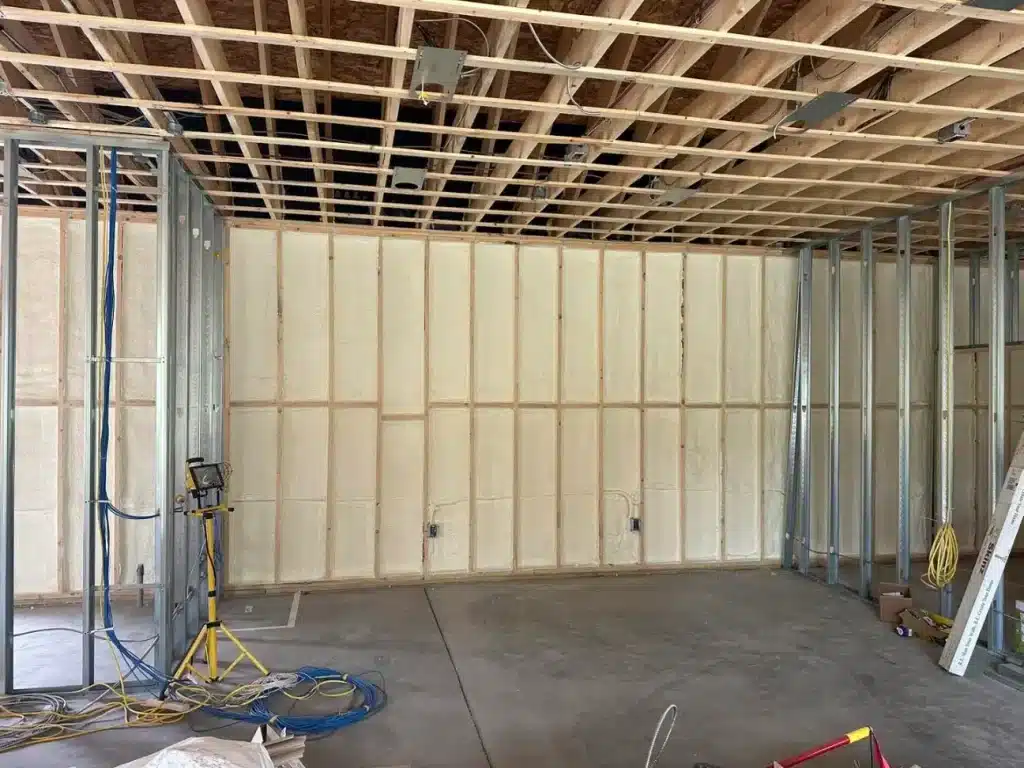
Traditional batt insulation often fails in this environment because it cannot eliminate air leakage effectively. Gaps, compression, and settling create thermal bridges that allow conditioned air to escape. Spray foam insulation expands on application to fill every cavity, crack, and penetration, creating an unbroken air seal that performs consistently despite outdoor temperature extremes.
The dry desert air also affects insulation performance. Low humidity means spray foam does not face the moisture accumulation problems common in humid climates, but it also means buildings lose moisture through air leakage more readily. An effective air barrier becomes essential for maintaining indoor comfort and controlling utility costs.
Open-Cell vs Closed-Cell: The Core Decision
The choice between open-cell and closed-cell spray foam forms the foundation of your insulation strategy. Each type offers distinct properties that make it better suited for specific applications.
Open-cell spray foam expands more dramatically during application, creating a softer, lighter material with millions of tiny open cells. This formulation provides excellent sound dampening and works well in interior wall cavities where flexibility helps absorb building movement. Open-cell typically achieves R-values between R-3.5 and R-3.7 per inch, making it effective but requiring greater thickness to reach target insulation levels.
Closed-cell spray foam is denser and more rigid, with sealed cells that resist water penetration and provide structural reinforcement to wall assemblies. This type achieves higher R-values between R-6.0 and R-7.0 per inch, meaning you need less thickness to achieve equivalent thermal resistance. Closed-cell also bonds to building substrates, adding measurable structural strength that open-cell cannot provide.
For Las Vegas properties specifically, closed-cell often performs better in exterior applications and areas exposed to temperature extremes. The rigidity helps the insulation maintain performance over decades of thermal cycling, while the moisture resistance protects against condensation issues during rare monsoon storms. Open-cell remains an excellent choice for interior wall cavities in climate-controlled living spaces where its sound-dampening qualities in spray foam.
Attic and Roof Deck Insulation
The attic represents the largest energy loss area in most Las Vegas homes. Summer heat buildup in unconditioned attics can exceed 150 degrees Fahrenheit, creating massive thermal loads that stress air conditioning systems. Closed-cell spray foam applied to the underside of the roof deck creates an unvented attic condition that keeps the space closer to interior temperatures while eliminating the need for ventilation that pulls hot outside air into the attic.
This approach costs more upfront but eliminates radiant heat gain through the roof sheathing, reducing cooling costs by 15 to 30 percent in many Las Vegas homes. The air seal also prevents conditioned air leakage through ceiling penetrations for lights, vents, and access hatches.
Exterior Walls
Both open-cell and closed-cell products work well in exterior wall cavities, but the application method matters. Open-cell expands more and can pressure-fit wall cavities if installed incorrectly, potentially bowing interior drywall. Professional installers understand proper injection techniques that allow open-cell to fill cavities without over-pressurizing.
Closed-cell works excellently in exterior walls where its moisture resistance provides an extra buffer against any water intrusion. For homes near the edge of the Las Vegas valley where radon concerns exist, closed-cell also provides a superior radon barrier when applied to foundation walls and slabs.
Floor and Crawl Space Insulation
Las Vegas homes with raised floors over unconditioned crawl spaces benefit significantly from floor insulation. Open-cell spray foam works well here, providing thermal resistance and sound dampening without the weight that closed-cell adds to floor assemblies. The flexibility accommodates any seasonal movement without cracking or degrading.
For homes with conditioned crawl spaces, closed-cell applied to the underside of subflooring creates an efficient thermal boundary while adding stiffness that reduces floor squeaks and bounce.
Cost Considerations and ROI
Spray foam insulation costs more than traditional options upfront, but Las Vegas utility rates and climate conditions create favorable return on investment scenarios. Open-cell installation typically runs $0.50 to $1.50 per board foot installed, while closed-cell ranges from $1.00 to $3.00 per board foot, depending on project complexity and access.
A typical 2,000 square foot Las Vegas home might see spray foam insulation costs ranging from $8,000 to $18,000, depending on whether open-cell or closed-cell is used and which areas receive treatment. Against average summer cooling bills of $300 to $500 per month during peak season, utility savings can help offset the upfront cost over time.
Many Nevada utility providers offer rebates for spray foam insulation upgrades. NV Energy provides qualifying energy efficiency incentives that can offset 10 to 20 percent of installation costs for eligible projects. Our team helps identify applicable rebates during the quoting process to reduce your net investment.
Evaluating Your Insulation Contractor
Not all spray foam contractors deliver the same quality, and installation errors can undermine even premium insulation products. Before hiring any contractor, verify their certifications and manufacturer partnerships. Certified installers complete manufacturer-specific training that ensures they understand proper mixing ratios, application temperatures, and installation techniques for each product line.
Ask potential contractors about their equipment. Professional spray foam installation requires heated hoses, precise ratio control, and adequate pressure for proper cell structure. Contractors using outdated or poorly maintained equipment often produce inconsistent foam with reduced performance.
Request three detailed bids that specify product type, R-value targets, coverage areas, and preparation requirements. Be wary of bids that come in significantly below market rates, as they often indicate shortened cure times, improper density, or products that do not meet manufacturer specifications.
Request documentation of previous projects in Las Vegas specifically. Climate conditions here create unique challenges that contractors unfamiliar with the region may not anticipate. Ask for references and follow up with previous clients about long-term performance and any issues that arose during or after installation.
Common Mistakes to Avoid
Choosing price over performance: The lowest bid often results in reduced foam density, inadequate coverage, or products inappropriate for your specific application. Insufficient density creates settled foam that leaves gaps over time, while improper product selection leads to moisture issues or thermal performance that falls short of projections.
Skipping air sealing details: Spray foam provides excellent air sealing when properly installed, but penetrations, electrical boxes, and plumbing runs require preparation and attention during application. Contractors who rush through these details leave bypass pathways that undermine overall performance.
Ignoring ventilation compatibility: In some retrofit applications where existing ventilation must remain functional, spray foam application requires careful planning to maintain proper airflow. Closed-cell works well in these situations, but open-cell formulations may require alternative approaches.
Failing to verify codes and permits: Las Vegas requires permits for spray foam insulation in certain applications. Professional contractors handle permit documentation and ensure all work meets local building codes. DIY projects or contractors who skip permits create complications during future property sales.
Not planning for cure time: Spray foam requires a cure time before other construction phases can proceed. Rushing this process leads to off-gassing issues, improper adhesion, and reduced performance. Professional contractors schedule work to allow adequate cure time between application and other trades.
Signs You Have Found the Right Approach
- Your contractor explains the performance differences between open-cell and closed-cell, specific to your Las Vegas property, rather than defaulting to one option
- The quote includes detailed R-value projections, air sealing performance estimates, and projected energy savings based on local utility rates
- The contractor asks about your HVAC system, occupancy patterns, and renovation plans before recommending a specific approach
- References from previous Las Vegas clients confirm long-term satisfaction and measurable utility bill reductions
- The installation crew addresses preparation details like sealing penetrations and protecting fixtures before applying foam
- Post-installation documentation includes warranty information, cure time guidance, and maintenance recommendations
Making the Final Decision
The right spray foam insulation choice balances performance requirements, budget constraints, and long-term value. For most Las Vegas homeowners, a hybrid approach works well: closed-cell spray foam for roof decks and exterior walls exposed to direct sun, with open-cell in interior wall cavities where sound dampening adds value. This strategy captures the benefits of both formulations while optimizing cost-effectiveness.
Our team at Supreme Spray Foam LV brings experience with Las Vegas climate conditions and works on properties throughout the Henderson and North Las Vegas areas. We evaluate each property individually, considering building construction, existing insulation conditions, and your specific comfort and efficiency goals before recommending an approach.
Whether you are insulating a new construction project or upgrading an existing property, our experienced installers focus on proper application technique for every product we use. We provide detailed proposals that explain the rationale behind each recommendation, so you understand exactly what you are paying for and the performance you can expect.
Contact us today for a comprehensive evaluation of your Las Vegas property. Reach us by email at info@supremesprayfoamlv.com or call 702-904-9895 to discuss your insulation needs and discover how spray foam can transform your property’s comfort and efficiency.
Sources
- International Energy Conservation Code: Climate Zone Map: Climate zone classifications and insulation requirements for Las Vegas Zone 9b compliance
- Energy Star: Insulation FAQs: General guidance on insulation R-values, air sealing principles, and energy efficiency standards for residential properties
- NV Energy: Energy Efficiency Rebates: Nevada utility rebate programs for qualifying insulation and energy efficiency upgrades