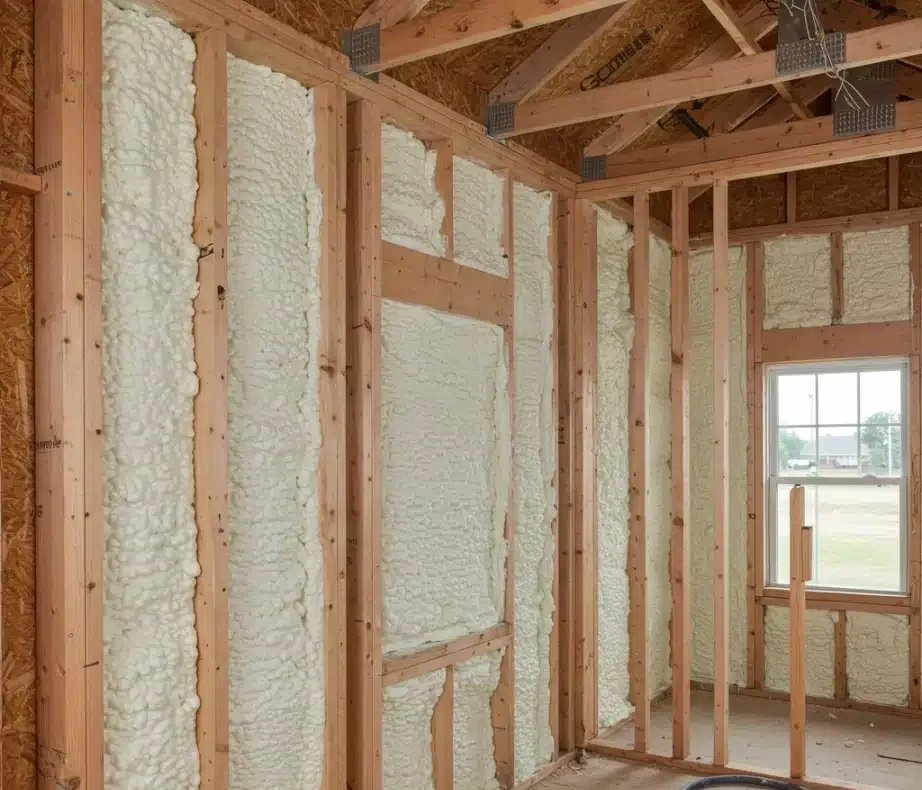

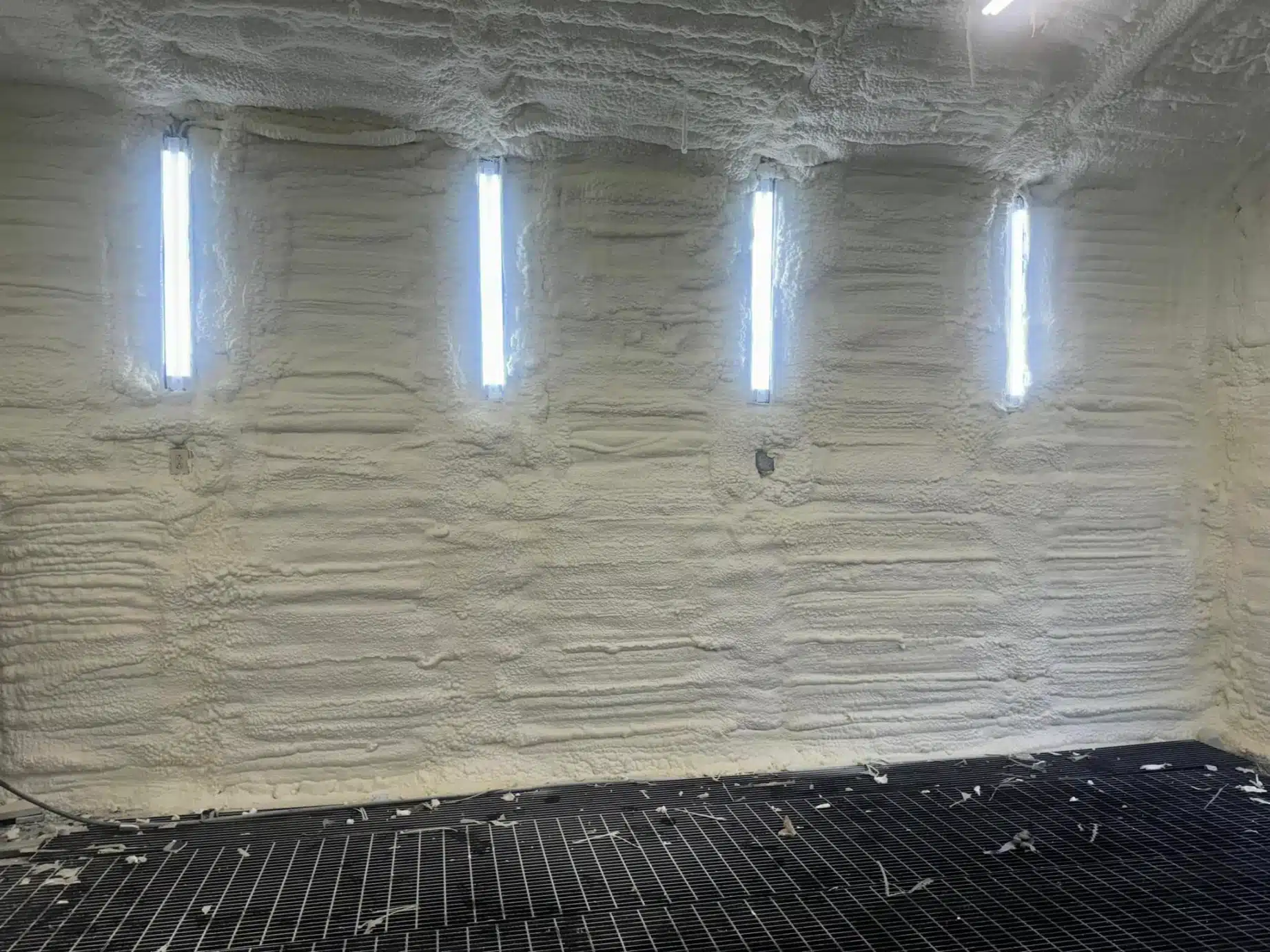
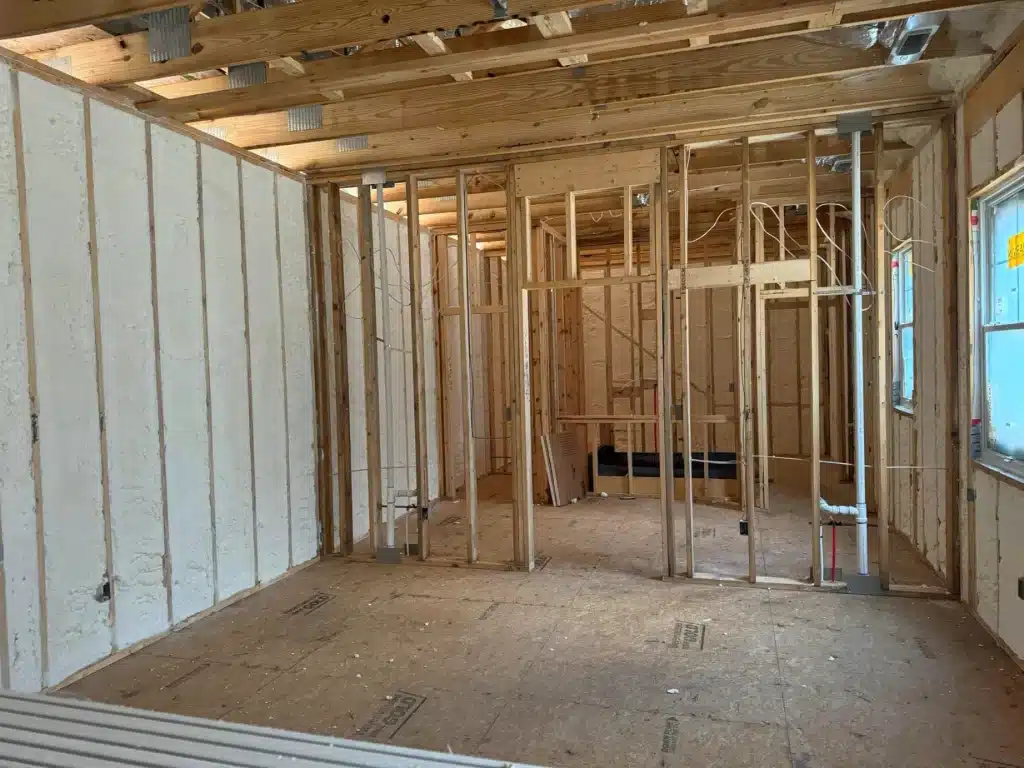
Closed-cell spray foam adds structural strength to home walls by bonding directly to framing members, sheathing, and exterior cladding, creating a rigid, monolithic assembly that dramatically improves a wall’s resistance to racking, shear, and wind uplift forces. When sprayed into wall cavities, the foam expands and cures into a dense material that essentially glues every component together. This adhesive action is what gives closed-cell spray foam its structural advantage over traditional insulation like fiberglass or cellulose, which simply sit in the cavity without bonding to surrounding materials. Multiple research studies, including those conducted by the NAHB Research Center and the University of Florida Hurricane Research Center, have demonstrated that walls insulated with closed-cell spray foam can achieve racking strength gains of 200% to 300% compared to uninsulated wall assemblies, highlighting the long-term closed-cell spray foam durability and efficiency benefits.
TL;DR
- Closed-cell spray foam bonds to studs, sheathing, and cladding, creating a rigid monolithic wall assembly that resists racking and shear forces.
- NAHB Research Center testing showed wall racking loads increased from 913 lbs to over 2,800 lbs on vinyl-clad walls filled with ccSPF at 16-inch stud spacing.
- University of Florida wind uplift tests found ccSPF increased roof deck resistance by 3 to 3.2 times its original capacity.
- Closed-cell foam delivers an R-value of 5.1 to 6.7 per inch while simultaneously serving as an air barrier and vapor retarder.
- Structural gains come from adhesive bonding and load distribution, not from the foam’s compressive strength alone.
- Open-cell spray foam does not provide meaningful structural reinforcement due to its low density and spongy texture.
What Makes Closed-Cell Spray Foam Different From Other Insulation
Not all spray foam delivers structural benefits. The distinction comes down to density and cell structure. Closed-cell spray foam (ccSPF) is a medium-density material, typically around 2 pounds per cubic foot, where each cell is completely sealed and filled with a low-conductivity gas. Open cell foam, by contrast, has a spongy, semi-rigid texture with cells filled with air. According to Wikipedia’s spray foam reference, closed-cell foam has a long-term thermal resistance R-value between 5.1 and 6 per inch, and when installed at a minimum thickness of 50 mm, it functions as both a vapor barrier and an air barrier. Open-cell foam delivers roughly R-3.8 per inch and cannot serve as a vapor barrier at typical installation thicknesses, making closed-cell foam systems for barns a stronger option for durability and moisture control.
The U.S. Department of Energy’s insulation guide confirms that while both foam types expand and cure to fill cavities, closed-cell foam is denser, more rigid, and offers stronger resistance against moisture and air leakage. That rigidity and adhesive quality is precisely what allow ccSPF to reinforce wall assemblies. Open-cell foam cannot provide this structural function because it lacks the density and adhesive shear strength needed to bond framing members together under load.
| Property | Closed Cell Spray Foam | Open Cell Spray Foam | Fiberglass Batts |
|---|---|---|---|
| Density | ~2.0 lb/ft³ | ~0.5 lb/ft³ | Low (loose fibers) |
| R-value per inch | 5.1 to 6.7 | ~3.8 | 3.0 to 3.8 |
| Air barrier | Yes (at 50mm+) | Yes (at 5.5 in+) | No |
| Vapor barrier | Yes | No | No |
| Structural reinforcement | Yes | No | No |
| Adhesive bonding | Strong bond to substrates | Weak bond | None |
How the Adhesive Bond Creates Structural Strength
The mechanism behind ccSPF’s structural benefit is straightforward. When sprayed into a wall cavity, the liquid foam expands 30 to 60 times its liquid volume and adheres to every surface it contacts: studs, plates, sheathing, electrical boxes, and any other penetrations. Once cured, this creates a continuous bond linking all wall components into a single rigid unit.
This matters because standard wall construction relies on individual mechanical fasteners (nails, screws) to hold components together. Under wind load or seismic forces, those fasteners can work loose or fail. When ccSPF fills the cavity, it distributes stress across the entire wall surface rather than concentrating it at fastener points. The NAHB Research Center described this in their racking study conclusions, noting that “during a design racking event such as a hurricane, there would be less permanent deformation of wall elements and possibly less damage to a structure that was braced with SPF-filled walls.”
The Building Science Corporation’s Residential Spray Foam Guide by Joseph Lstiburek explains that spray foam provides continuity of the water control, air control, vapor control, and thermal control layers. That continuity also translates into structural continuity, as the foam eliminates the gaps and voids where walls are weakest.
Research Data on Racking and Wind Uplift Resistance
The structural claims behind ccSPF are backed by decades of laboratory testing and real-world observation. The IIBEC article by Mason Knowles documents three major research studies conducted between 1992 and 2007.
1992 NAHB Research Center Racking Study: Researchers tested ccSPF installed at 3 inches in wall panels using 2×4 wood studs at varying spacing. Results showed ccSPF increased the maximum average racking load of a vinyl-clad wall assembly from 913 lbs to over 2,800 lbs at 16-inch stud spacing, and maintained loads exceeding 2,300 lbs even at 48-inch stud spacing. For plywood-clad walls, ccSPF doubled the maximum average racking load at 16-inch spacing.
1996 NAHB Follow-up Study: Testing focused on OSB- and drywall-clad walls with metal studs at 16 inches on center. ccSPF at 3 inches increased drywall-clad wall racking load from 2,400 lbs to 5,380 lbs, and OSB-clad walls from 4,800 lbs to 6,000 lbs.
2007 SPFA Study: Tested at Architectural Testing, Inc., this study found ccSPF doubled the racking load of polyiso-sheathed wall assemblies, from 1,109 lbs to approximately 2,200 lbs.
University of Florida Wind Uplift Testing (2008): Researchers at the Hurricane Research Center tested wood roof deck assemblies built to Florida Building Code high-wind requirements. A 3-inch ccSPF fill increased wind uplift resistance from 3 to 3.2 times the original capacity.
| Study | Year | Wall Assembly Type | Racking Load Without ccSPF | Racking Load With ccSPF | Increase |
|---|---|---|---|---|---|
| NAHB RC | 1992 | Vinyl-clad, 16″ OC | 913 lbs | 2,800+ lbs | ~207% |
| NAHB RC | 1992 | Plywood-clad, 16″ OC | 2,890 lbs | 5,300 lbs | ~83% |
| NAHB RC | 1996 | Drywall-clad, metal studs | 2,400 lbs | 5,380 lbs | ~124% |
| NAHB RC | 1996 | OSB-clad, metal studs | 4,800 lbs | 6,000 lbs | ~25% |
| SPFA/ATI | 2007 | Polyiso-sheathed | 1,109 lbs | ~2,200 lbs | ~98% |
Real-World Performance in Hurricanes and High-Wind Events
Laboratory numbers become more meaningful when validated by field performance. The IIBEC article documents multiple case studies where ccSPF-insulated structures survived hurricanes while adjacent uninsulated sections were destroyed.
During Hurricane Katrina, a shrimp and ice processing facility in Pascagoula, Mississippi, lost its tongue-and-groove wood roof deck to internal pressurization. However, a connected metal building section that was insulated with ccSPF survived with no structural damage. Similarly, a Port Isabel, Texas lumber building insulated with ccSPF in 1980 survived both Hurricane Allen (Category 5) and Hurricane Dolly (Category 2, 2009), while a newer section without ccSPF lost half its roof during Dolly.
These observations are consistent across decades of hurricane investigations. The foam acts as an adhesive that holds building components together, distributes wind loads evenly across surfaces, and reduces the chance of fastener pull-through or panel separation.
Additional Benefits Beyond Structural Reinforcement
While structural strength is the focus here, ccSPF delivers multiple overlapping benefits that make it a practical choice for homeowners and builders.
Moisture control: Closed-cell foam serves as both an air barrier and a Class II vapor retarder, preventing condensation within wall assemblies. The Building Science Corporation guide notes that in IECC Climate Zones 5 through 8, ccSPF at 1.5 inches provides the condensation control needed without an additional interior vapor retarder.
Energy efficiency: The Oak Ridge National Laboratory report on spray foam retrofits documents that improving the building thermal envelope with spray foam reduces heating and cooling energy consumption by sealing air leaks that account for a significant portion of energy loss in typical homes. The DOE notes that foam insulation can fill even the smallest cavities while simultaneously creating an effective air barrier.
Flood resistance: ccSPF has been classified as a Class 5 material by the Federal Emergency Management Agency, the highest rating for floodwater resistance. This makes it the only cavity insulation approved by FEMA with this designation, relevant for homes in flood-prone regions.
Where Closed Cell Spray Foam Is Most Effective
Not every wall or project demands the structural reinforcement that ccSPF provides. The right application depends on climate zone, building type, and project goals.
New construction in high-wind or seismic zones: ccSPF is especially valuable where racking resistance matters. Builders in hurricane-prone or earthquake-active regions benefit most from the adhesive bonding and load distribution properties.
Retrofit insulation in older homes: When walls are opened during renovation, spraying ccSPF into existing cavities adds both thermal performance and structural stiffening without requiring additional bracing.
Crawl spaces and basement rim joists: ccSPF seals and insulates these notoriously leaky areas while adding rigidity to the floor framing above. The Building Science Corporation guide recommends only high-density closed-cell foam for vented crawlspaces in all IECC climate zones.
Hybrid wall assemblies: Builders can combine a thin layer of ccSPF against the sheathing with fiberglass or cellulose in the remaining cavity. This approach meets vapor control requirements while managing material costs.
Signs You Have Found the Right Spray Foam Installer
Choosing the right installer directly affects both structural and thermal performance. Look for these indicators:
- Detailed wall assembly knowledge: A qualified installer understands how ccSPF interacts with sheathing, cladding, vapor barriers, and building code requirements for your specific climate zone.
- Clear explanation of structural benefits: The installer should be able to explain how the adhesive bond works, what racking resistance means for your home, and which wall assemblies benefit most.
- Reference to testing and standards: Strong installers reference NAHB, SPFA, ASTM, and building code standards when discussing performance expectations.
- Proper equipment and certification: Spray foam application requires specialized equipment and training. Certified installers follow manufacturer guidelines for temperature, thickness, and curing conditions.
- Transparent communication: The best providers walk you through what to expect before, during, and after installation, including curing times, occupancy protocols, and long-term performance expectations.
Ready to Strengthen Your Walls?
At Supreme Spray Foam LV, our experienced team specializes in closed cell spray foam installations that deliver both structural reinforcement and superior thermal performance for homes in Las Vegas and the surrounding area. Whether you are building new, renovating, or retrofitting an older home, we assess your wall assemblies and recommend the right approach for your specific project. Reach out to us today to discuss how closed-cell spray foam can protect and strengthen your home.
Call us at (702) 904-9895 or email [email protected] to get started.
Frequently Asked Questions
Does closed-cell spray foam replace the need for structural sheathing?
A: No. ccSPF significantly increases racking strength, but it does not replace code-required structural sheathing. It works as a complementary reinforcement that bonds sheathing, studs, and cladding into a stronger assembly.
Can spray foam be added to existing walls without removing drywall?
A: In some cases, slow-curing injection foam can be installed through small holes, but this does not provide the same structural bonding as sprayed ccSPF. For full structural benefit, wall cavities need to be open during application.
How much racking strength does closed-cell spray foam actually add?
A: According to NAHB Research Center testing, ccSPF increased vinyl-clad wall racking loads by over 200% and plywood-clad walls by up to 120%, depending on stud spacing and cladding type.
Is the structural benefit recognized by building codes?
A: Building codes do not currently allow ccSPF to substitute for required bracing or shear panels, but the research data is well documented. Engineers can factor the added stiffness into structural calculations for performance-based design.
Does open-cell spray foam also strengthen walls?
A: No. Open-cell foam is semi-rigid and spongy, with a density of around 0.5 lb/ft³. It seals air leaks effectively but does not bond structural components together with sufficient strength to improve racking resistance.
Sources
- IIBEC – The Use of Closed-Cell Spray Polyurethane Foam to Enhance Structural Properties of Wall and Roof Assemblies – Mason Knowles’ detailed article documenting NAHB racking studies, University of Florida wind uplift testing, and hurricane field observations across multiple storms.
- Building Science Corporation – GM-2102: Residential Spray Foam Guide – Joseph Lstiburek’s comprehensive guide on spray foam applications in walls, roofs, and foundations, including vapor control requirements by climate zone.
- Wikipedia – Spray Foam – Reference covering closed cell and open cell properties, R-values, density specifications, and air barrier performance thresholds.
- U.S. Department of Energy – Types of Insulation – Government resource comparing insulation types, including spray foam characteristics, installation methods, and advantages over traditional materials.
- OSTI – Spray Foam in Accessible Spaces: Best Practices and Case Studies for Retrofit in Mixed-Humid Climates – Oak Ridge National Laboratory technical report on spray foam retrofits covering energy performance, air sealing effectiveness, and moisture control in existing homes.