
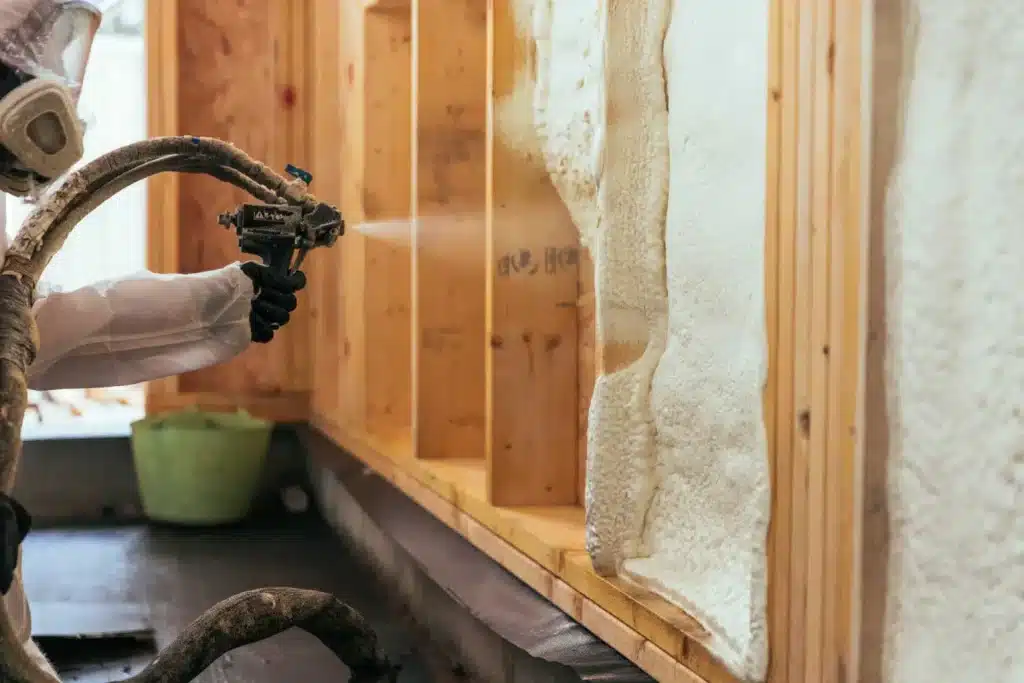
Yes, closed-cell spray foam is generally one of the strongest insulation matches for challenging building conditions in Las Vegas, NV, though the right specification depends on the assembly being insulated, its exposure to heat, wind, and moisture, and the care taken during installation. For roof decks, metal and masonry walls, crawlspaces, garages, and commercial shells facing triple-digit heat and monsoon-season humidity, closed-cell spray foam durability and efficiency matter because closed-cell foam brings high R-value per inch, air-sealing performance, and vapor resistance in a single application. For interior partitions where sound damping matters more than moisture control, open-cell foam may serve just as well. Below, we break down how the material behaves under desert conditions, where it fits best, what building code expects, and how to judge an approach before you commit.
TL;DR
- R-value density: Medium-density closed-cell spray foam delivers roughly R-5.1 to R-6.0 per inch, compared with about R-3.8 per inch for open-cell foam, so it reaches code targets in thinner cavities .
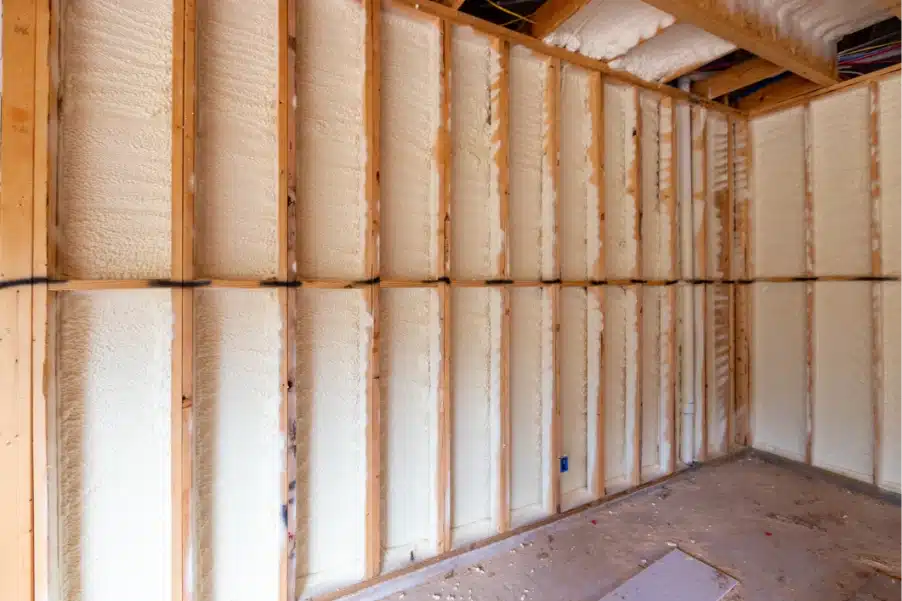
- Triple duty in one pass: At about 2 inches of thickness, closed-cell foam acts as insulation, an air barrier, and a vapor barrier simultaneously.
- Air leakage drives desert energy loss: Research cited by the U.S. Department of Energy attributes roughly 40% of a home’s energy loss to air infiltration through walls, windows, and doorways, which foam sealing addresses directly.
- Heat extremes are the norm: Las Vegas has recorded 117°F highs and stretches of nine or more consecutive days at or above 110°F (NWS Las Vegas).
- Monsoon moisture is a real design factor: July and August bring elevated humidity, thunderstorms, and flash flooding to the valley, even though it is the driest major metro area in the continental U.S. (NWS Climate of Las Vegas).
- Code baseline: Under 2021 IECC Zone 3 targets, expect R-49 ceilings and R-20 wood-frame walls in new residential work (U.S. Department of Energy).
- Main pitfall: Foam applied over damp substrates or outside manufacturer temperature and humidity limits can under-expand, trap moisture, or fail to cure, so crew discipline matters more than the product label.
Why Las Vegas Building Conditions Are So Demanding
Las Vegas sits in a broad desert valley where summer temperatures routinely reach the triple digits, while the coldest winter nights drop into the 20s. That is a wide operating range for any building envelope, and it punishes materials that rely on loose fills or stapled batts that can shift, gap, or sag over time (NWS Climate of Las Vegas).
Three local conditions shape insulation decisions more than anything else:
- Sustained extreme heat: The urban heat island keeps central valley nights 5 to 15 degrees warmer than outlying areas, so cooling systems run long hours with little overnight recovery.
- Monsoon season swings: Moisture surges in July and August raise humidity and trigger thunderstorms whose runoff pours into low-lying areas and dry washes, creating brief but intense wetting events.
- Wind and dust: Gusts strong enough to carry blowing sand occur most often in spring and fall, and the local climate record documents repeated gusts at 58 mph or higher, which drives air and dust through any weak point in the envelope (NWS Las Vegas Climate Book).
An insulation system in this market has to block conductive heat gain, stop air-driven dust and heat movement, and tolerate occasional wetting without losing performance. That is a tall order for a single material, which is exactly where a closed-cell spray foam service earns its reputation.
How Closed-Cell Spray Foam Performs Under Desert Conditions
Closed-cell spray foam, often called two-pound foam, is a rigid thermoset plastic with millions of sealed cells. Because each cell is closed and the material is sprayed in place, it conforms to irregular surfaces, seals cracks and construction joints, and blocks all three modes of heat transfer: conduction, convection, and radiation (Spray foam – Wikipedia).
| Property | Closed-Cell Foam | Open-Cell Foam | Fiberglass Batts |
|---|---|---|---|
| Approximate R-value per inch | R-5.1 to R-6.0 | ~R-3.8 | R-3 to R-4 |
| Air barrier | Yes, at modest thickness | Yes, at 5.5 inches or more | No, requires separate sealing |
| Vapor resistance | Yes, at about 2 inches | Weak at thin layers | None |
| Moisture exposure tolerance | High, used on boats and containers | Low, interior use only | Low, can hold water |
| Best Las Vegas use | Roofs, exterior walls, crawlspaces, metal buildings | Interior sound walls, attics with vented design | Budget interior cavities |
Two performance traits matter most in Las Vegas. First, the air-sealing effect attacks the single biggest energy leak in most buildings, since roughly 40% of home energy loss traces to air infiltration. Second, the dense closed-cell structure resists moisture, which is why the closed-cell spray foam in Las Vegas, NV, is widely used in environments exposed to fluctuating temperatures and humidity, from boats to commercial roofs. During monsoon weeks, when a wall assembly may take on humidity and a sudden downpour in the same day, that resilience is a meaningful advantage.
Where Closed-Cell Spray Foam Fits Best in Las Vegas Projects
| Application | Suitability | Why It Works Here |
|---|---|---|
| Underside of roof deck | Excellent | Keeps attic ducts in conditioned space and cuts radiant heat gain from a 150°F+ deck |
| Masonry and CMU walls | Excellent | Adheres to uneven concrete and blocks air and vapor movement through porous block |
| Metal buildings and workshops | Excellent | Conforms to corrugated profiles and limits condensation on steel |
| Crawlspaces and stem walls | Excellent | Handles ground moisture and seals rim-joist penetrations |
| Vented attics (floor application) | Good | Works, but a sealed roof deck usually outperforms in cooling-dominated zones |
| Interior bedroom partitions | Fair | Open-cell is the better fit for sound damping at lower density |
The Department of Energy’s own air-sealing guidance highlights closed-cell spray foam for rim joists and wall cavities in retrofit work, noting that walls and rim joists make up more than 40% of a home’s total envelope area (U.S. Department of Energy). In practice, that means the areas hardest to seal with other materials are the ones where foam delivers the most leverage.
Code, Climate Zone, and Drying Considerations
Southern Nevada falls in the cooling-dominated, hot-dry part of the country under the IECC climate zone structure DOE references. For Zone 3, the 2021 IECC table calls for R-49 in uninsulated attic ceilings and R-20 in wood-frame walls, either of which closed-cell foam can meet within standard cavity depths (U.S. Department of Energy).
A few code and building-science points to plan around:
- Vapor placement matters. In a cooling-dominated climate, the vapor drive generally runs inward during long cooling seasons, so exterior closed-cell layers must be detailed so assemblies can still dry where they need to.
- Thermal and ignition barriers are required. Interior foam generally needs an approved thermal barrier such as drywall in living spaces.
- Ducts benefit too. The IECC prescribes R-8 for supply and return ducts larger than 3 inches located outside conditioned space, and encapsulating a roof deck with foam moves those ducts inside the envelope.
Recommendations by Building Type
| Audience / Context | Recommended Approach | Key Notes |
|---|---|---|
| Production builders | Closed-cell at roof deck plus hybrid wall cavities | Hits Zone 3 targets while controlling material use |
| Custom home projects | Full closed-cell envelope with blower-door verification | Comfort and dust control are top owner requests |
| Commercial and industrial owners | Closed-cell on masonry and steel assemblies | Condensation control on steel is a major win |
| Remodelers and additions | Targeted closed-cell at rim joists, garages, and problem walls | DOE guidance specifically endorses foam in these zones |
| Homeowners near washes or flood-prone lots | Closed-cell in crawlspace and lower walls | Tolerates wetting events better than fibrous materials |
Common Mistakes That Undermine Performance
- Spraying over damp or dusty substrates, which prevents adhesion and can trap moisture in the assembly.
- Pushing beyond manufacturer limits for substrate temperature, ambient heat, or single-pass thickness, which causes off-ratio foam, voids, or poor cell structure.
- Skipping the thermal barrier where code requires one.
- Sealing a roof deck without planning ventilation or equipment changes, leaving the attic HVAC strategy mismatched.
- Treating foam as a substitute for drainage and flashing, when it is only part of the water-management picture.
Signs You’ve Found the Right Approach
You are on solid ground when the contractor talks assembly science, not just price per board foot. Look for a crew that asks about your existing ventilation, verifies substrate moisture and temperature before spraying, quotes thickness and yield in writing, explains vapor and thermal barrier code requirements for your jurisdiction, and offers verification such as blower-door testing after the work. Transparency about substrate prep, cure times, and re-occupancy windows is a strong signal the installation will perform in Las Vegas conditions rather than merely look complete.
Get a Closed-Cell Plan Built for the Mojave
Our team at Supreme Spray Foam LV designs closed-cell spray foam systems around the heat, wind, and monsoon moisture that Las Vegas buildings actually face, from residential roof decks to commercial masonry shells. We evaluate your assembly, confirm code requirements, and apply foam under strict temperature and moisture limits so the finished envelope performs for decades. Reach us at (702) 904-9895 or email [email protected].
When your insulation has to hold up against 117°F afternoons and monsoon downpours in the same season, trust the crew that insulates for the desert every day.
Frequently Asked Questions
Is closed-cell spray foam a good choice for Las Vegas heat?
Yes. Its R-5.1 to R-6.0 per inch rating and continuous air seal directly reduce the heat gain and infiltration that dominate cooling loads in cooling-dominated southern climates.
Does closed-cell spray foam work as a vapor barrier in the desert?
Yes. At roughly 2 inches of thickness it functions as both an air barrier and a vapor barrier, which helps during monsoon-season humidity spikes even in an otherwise dry climate.
Can foam be applied to a hot roof deck in summer?
Yes, with care. Crews must verify substrate temperature and moisture conditions against manufacturer limits, often spraying in early morning passes, to guarantee proper adhesion and cure.
How thick does closed-cell spray foam need to be in Las Vegas?
Typical assemblies use 2 to 3 inches in walls and more at roof decks to approach Zone 3 targets of R-20 walls and R-49 ceilings, with exact thickness determined by your assembly design.
Does closed-cell spray foam add structural value?
It can help. Its dense, rigid structure adheres to framing and sheathing and is recognized for contributing to air tightness and structural rigidity at joints and cracks.
Sources
- Spray foam – Wikipedia – Reference overview of spray polyurethane foam types, R-values, vapor and air barrier behavior, and applications in demanding environments.
- National Weather Service – Climate of Las Vegas – Official NWS summary of Las Vegas heat, monsoon moisture, flash flooding, winds, and urban heat island effects.
- NWS Las Vegas – Record Breaking Heat Wave Hits Southwest US – Documented record temperatures, including Las Vegas’ 117°F high and multi-day stretches at or above 110°F.
- U.S. Department of Energy – Insulation and Air-Sealing Essentials – DOE guidance on 2021 IECC climate zones, R-value requirements, and air-sealing methods including closed-cell spray foam.
- NWS Las Vegas – Las Vegas Climate Book – Maintained archive of Las Vegas temperature, precipitation, thunderstorm, and high-wind records used for local design planning.

- How Do You Choose the Right Insulation for a Las Vegas, NV Property Without Guesswork? - September 16, 2026
- What Questions Should Peccole Ranch, NV Property Owners Ask About Spray Foam Insulation? - September 16, 2026
- Where Can Spray Foam Insulation Be Used When Access Is Limited or Restricted? - September 15, 2026