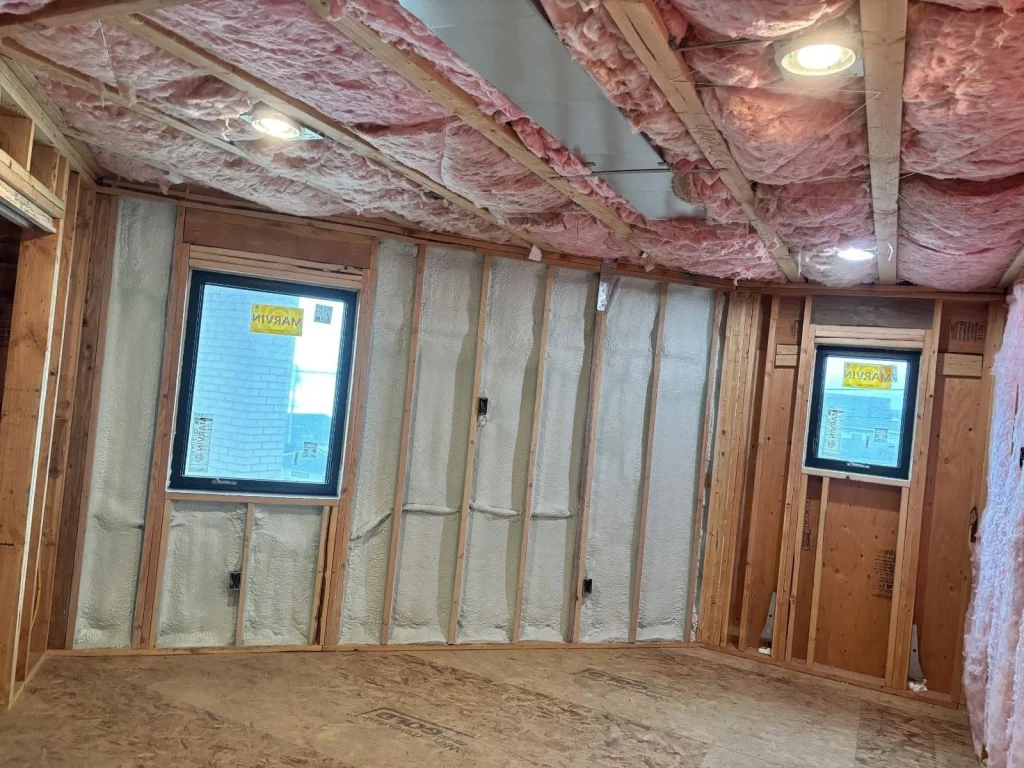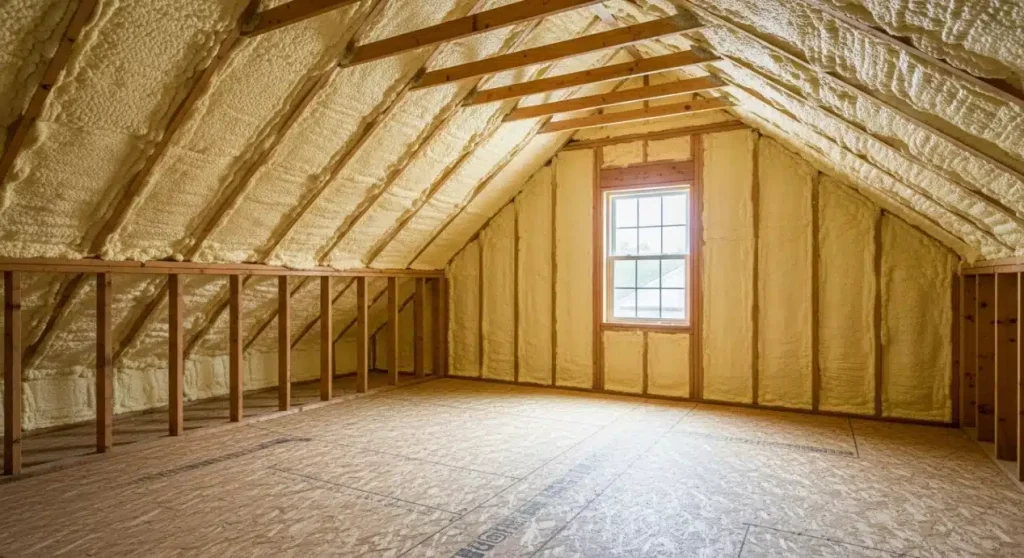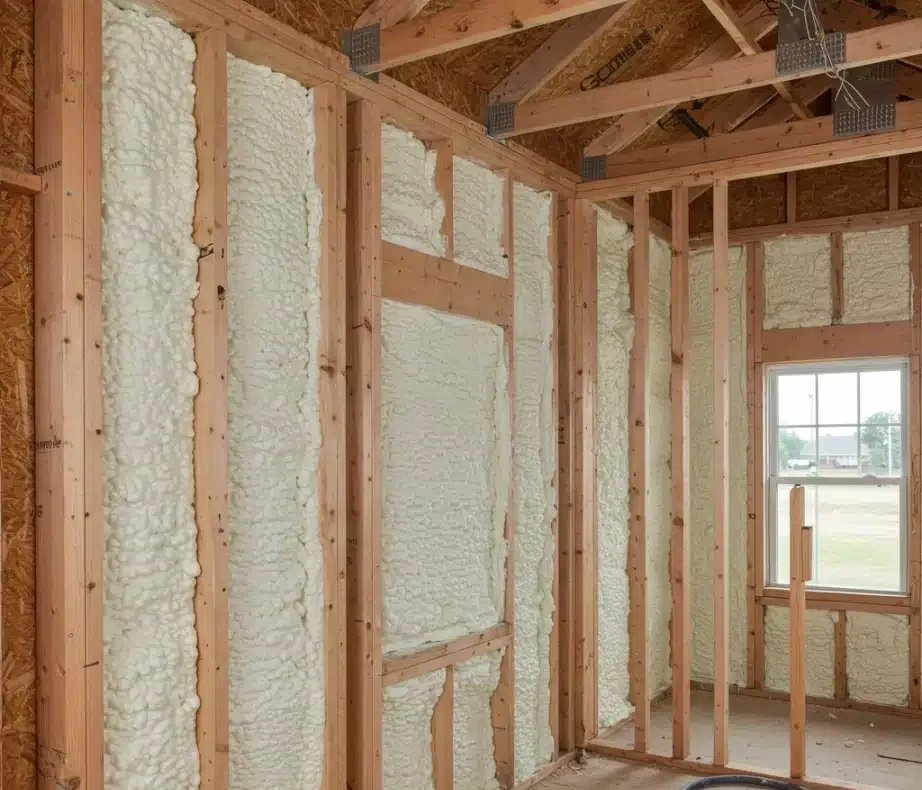


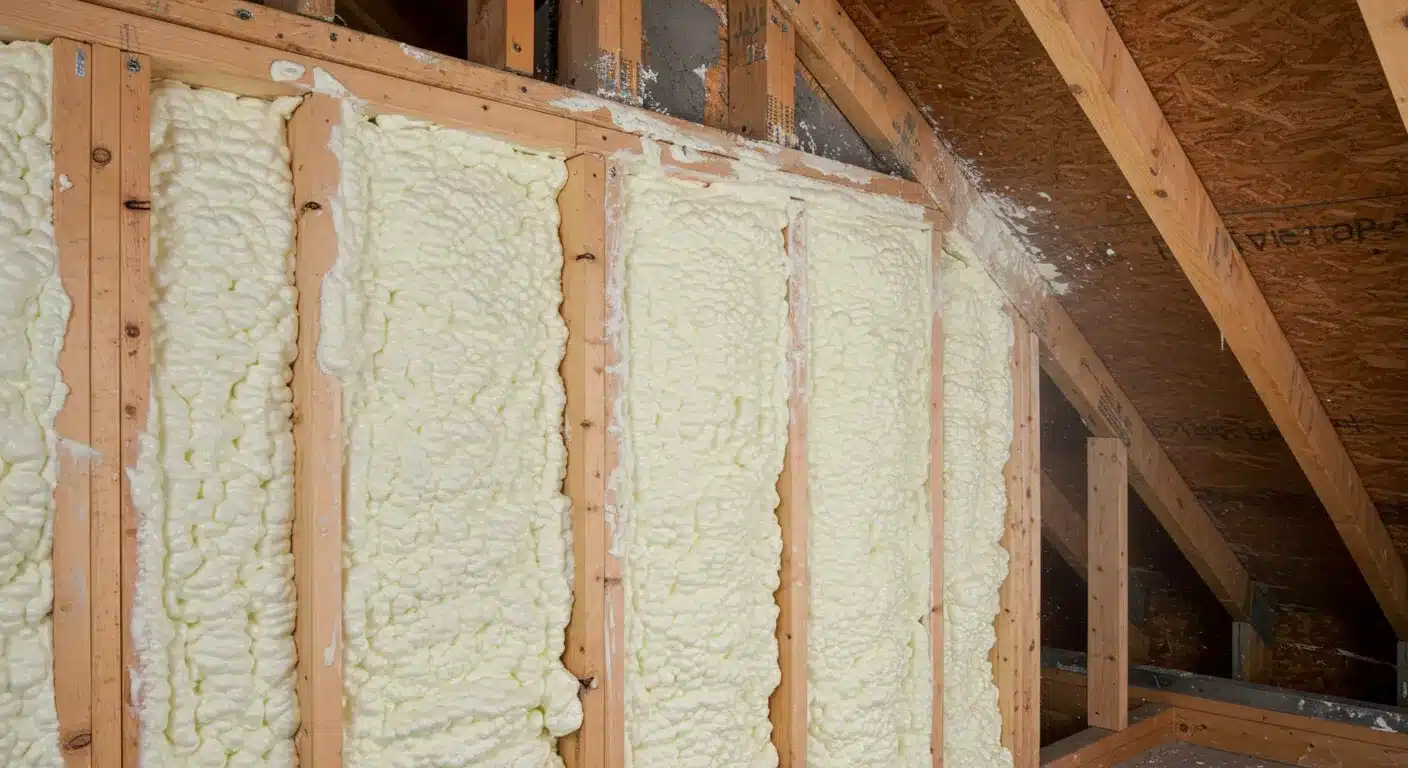
Open-cell spray foam makes the most sense for large rooms and interior areas where air sealing, full cavity coverage, and sound control matter more than moisture resistance. For builders, remodelers, and homeowners planning projects in dry climates like Las Vegas and Southern Nevada, open cell spray foam advantages, uses, and performance typically means open floor plans, great rooms, interior partition walls, media rooms, ceilings between levels, and attic or roof-deck assemblies. Open-cell is generally the wrong specification where the foam will face direct moisture, ground contact, or continuous high humidity, which is where closed-cell foam is the safer call. The right choice depends on the assembly, the climate zone, and whether the goal is quiet, comfort, or thermal performance.
TL;DR
- Open-cell foam (half-pound) expands during installation, filling cracks, crevices, and irregular cavities, and it functions as an air barrier at roughly 5.5 inches of thickness or more.
- Typical performance sits near R-3.6 to R-3.8 per inch, compared with R-5.1 to R-6.0 for closed-cell foam, so open-cell needs deeper cavities to hit the same numbers.
- Open-cell stays vapor-permeable, which suits interior walls and dry climates, but rules it out for damp or below-grade spaces.
- Its soft, porous structure absorbs airborne sound, making it a favorite for media rooms, bedrooms, offices, and walls between living spaces.
- Open-cell foams are water-blown with no trapped HFC blowing agents, so their R-value holds steady over the years instead of drifting as gases diffuse out.
- Foam expands up to 30 to 60 times its liquid volume, so large cavities and open ceilings fill quickly with fewer passes.
- Federal FTC R-value disclosure rules apply to insulation quotes, so every estimate you receive should state tested R-values in writing.
What Sets Open-Cell Spray Foam Apart
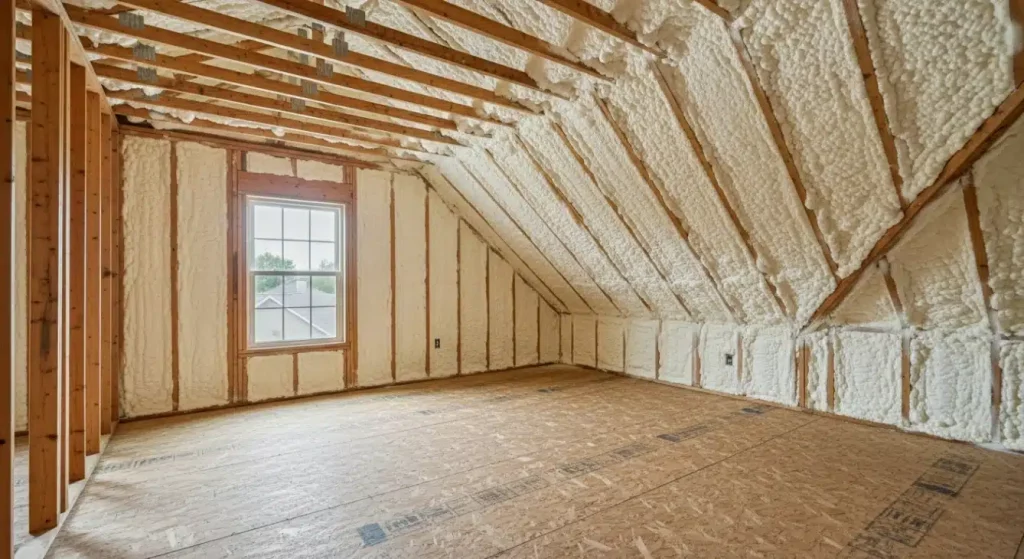
Open-cell spray polyurethane foam is a light-density, half-pound material with a sponge-like texture. As it is sprayed, it expands and creates millions of small, open cells, then adheres to whatever surface it touches, including irregular framing, blocking, and around electrical boxes. That expansion is what makes it an air-sealing insulation: it fills voids that batts and boards leave behind, and it blocks the convective heat transfer that leaks through gaps in the building envelope.
The trade-off is density. Because the cells are open and filled with air rather than a sealed gas, the material insulates at roughly R-3.6 to R-3.8 per inch, while closed-cell foam ranges from R-5.1 to R-6.0 per inch. Per-inch comparisons only tell part of the story, though, and the R-value reference page on Wikipedia explains why: R-values are additive by thickness, and real-world wall performance also depends on framing, thermal bridging, and air leakage, not just the insulation label.
Open-Cell vs. Closed-Cell at a Glance
| Property | Open-Cell Spray Foam | Closed-Cell Spray Foam |
|---|---|---|
| Density | Half-pound, soft and flexible | Two-pound, rigid |
| R-value per inch | Approx. R-3.6 to R-3.8 | Approx. R-5.1 to R-6.0 |
| Vapor behavior | Permeable, not a vapor barrier | Acts as a vapor barrier at sufficient thickness |
| Air sealing | Air barrier at about 5.5 inches or more | Air barrier at thinner applications |
| Expansion | Very high, fills large cavities fast | Moderate expansion |
| Best fit | Interior walls, ceilings, dry-climate attics, sound control | Exteriors, crawlspaces, basements, damp assemblies |
| Sound damping | Strong, absorbs airborne noise | Moderate |
Neither option is universally better. Open-cell wins on speed, coverage, and acoustics inside conditioned space. Closed-cell wins wherever moisture, thin cavities, or higher R-per-inch demands drive the specification.
Where Open-Cell Makes Sense in Large Rooms and Interiors
We specify open-cell most often in these situations:
- Open floor plans and great rooms. Large ceilings and roof decks have vast, uninterrupted cavities. High expansion lets one continuous air seal form across the whole plane, which is exactly where traditional insulation struggles.
- Interior partition walls. Open-cell is frequently used inside interior walls because it reduces sound transfer by both blocking and absorbing air leakage paths, per the spray foam overview on Wikipedia.
- Media rooms and home theaters. The soft, porous cell structure dampens mid-range airborne noise, keeping dialogue and sound systems inside the room.
- Ceilings and floors between levels. Filling the cavity between a second story and a first-story living space cuts both sound transfer and conditioned-air loss.
- Bonus rooms over garages. These spaces usually have extreme exposure; sealing the floor and knee walls with open-cell, in a dry climate, stabilizes temperatures dramatically.
- Dry-climate wall cavities. In Southern Nevada’s arid environment, interior vapor permeability is far less of a liability than it would be in a humid region.
Recommendations by Room and Goal
| Space or Goal | Recommended Approach | Key Notes | Expected Outcome |
|---|---|---|---|
| Great room, open ceiling | Full open-cell application to the roof deck | Verify target R-value for your climate zone | Even temperatures, sealed envelope |
| Media room | Open-cell in all partition walls and ceiling | Pair with sealed doors for best results | Noticeably quieter room |
| Bedroom walls facing living areas | Open-cell in the shared wall | Fast install, no major demolition | Reduced voice and TV noise |
| Garage ceiling under a bonus room | Open-cell in the floor cavity | Confirm local code barrier requirements | Warmer, quieter room above |
| Humid crawlspace or exterior wall | Closed-cell instead | Open-cell is usually recommended only for indoor applications | Moisture-safe performance |
When Open-Cell Is the Wrong Choice
Open-cell spray foam service is usually recommended only for indoor applications, and there are good reasons for that. Because air moves through its open cell structure, thin layers do not act as a vapor barrier. Anywhere the foam will sit against ground moisture, standing water risk, or continuously humid air, closed-cell is the correct specification. Skipping this distinction is the single most common mistake we see on insulation plans, and it can lead to concealed condensation problems inside an assembly.
Open-cell also needs depth. In a shallow cavity where you need maximum R-value in limited space, closed-cell delivers more resistance per inch. Finally, spray foam left exposed inside occupied spaces generally requires an approved thermal or ignition barrier covering under building codes, which should be planned for from the start rather than added after inspection.
Matching Thickness to Your Climate Zone
Insulation targets are not one-size-fits-all. Energy Star publishes recommended R-values by climate zone, based on the 2021 International Energy Conservation Code, and these targets should anchor any large-room insulation plan. The Energy Star recommended R-value guide breaks down attic, wall, and floor targets by zone, for example:
| Climate Zone | Attic (Uninsulated) | Attic (Existing 3-4 in.) | Floor |
|---|---|---|---|
| Zone 2 | R49 | R38 | R13 |
| Zone 3 | R49 | R38 | R19 |
| Zones 4A and 4B | R60 | R49 | R19 |
In hot-dry regions like ours, the attic and roof deck usually carry the highest targets, which is why large open-ceiling rooms benefit so much from a continuous open-cell air seal.
Long-Term Performance and Aging
One underappreciated advantage of open-cell foam is stability. Because open-cell products are blown with water and contain no trapped HFC gases, their insulating value does not meaningfully drift over time. Closed-cell foam, by contrast, can lose R-value over the years as its blowing agent diffuses out and is replaced by air; long-term material testing cited on the R-value (insulation) page documented double-digit percentage R-value loss in closed-cell polyurethane samples. For an interior wall or ceiling that will never be opened again, that durability matters.
What to Expect on Install Day
Spray polyurethane foam is created on site from two chemical components, side A (isocyanates) and side B (a polyol blend), which react at the spray gun in an exothermic reaction, as described by the EPA’s overview of spray foam chemistry. That means professional application, proper protective equipment, and staged ventilation are standard practice. Occupants and pets stay out during application and curing, and once fully cured, the foam is inert. Planning the schedule around this re-occupancy window is part of a professional install.
Signs You Have the Right Insulation Plan and Provider
Use this checklist before signing any insulation contract:
- Written R-value documentation. The FTC’s R-Value Rule requires manufacturers, installers, and retailers to disclose tested R-value information, so a quote without it is a red flag.
- Climate-zone targets in the proposal. The plan should reference zone-appropriate R-values, not generic marketing claims.
- A moisture strategy. The provider should explain why open-cell fits your assembly, or where closed-cell belongs instead.
- Acoustic goals addressed. For sound-driven projects, all shared walls, not just exterior ones, should be in scope.
- Code compliance for exposed foam. Thermal or ignition barrier coverage should be specified up front.
- Clear re-occupancy guidance. You should know exactly when the space is safe to re-enter.
Get a Room-by-Room Recommendation From Supreme Spray Foam LV
Choosing between open-cell and closed-cell comes down to your specific rooms, assemblies, and goals, and that is exactly what we evaluate every day. At Supreme Spray Foam LV, we assess large rooms, interior walls, ceilings, and attic spaces across Las Vegas and Southern Nevada, then specify the foam type and thickness that fits each cavity. Call us at (702) 904-9895 or email [email protected] to get started.
The right foam, in the right place, at the right thickness, is what turns a drafty, noisy room into a quiet, comfortable one. Let’s plan yours.
Frequently Asked Questions
How thick does open-cell spray foam need to be to stop air movement?
Most open-cell products function as an air barrier at about 5.5 inches of thickness or more. Below that, air can still move through the open cell structure.
Is open-cell spray foam good for soundproofing between rooms?
Yes. Its soft, open-celled structure absorbs and blocks airborne sound, which is why it is a common choice for interior partition walls, media rooms, and bedrooms. It works best on all shared walls of the room you are treating.
Does open-cell spray foam work as a vapor barrier?
No, open-cell foam is vapor-permeable. That suits dry interior conditions and arid climates, but closed-cell foam should be used wherever moisture exposure is a concern.
Does open-cell foam lose R-value as it ages?
No significant drift is expected because open-cell products are water-blown and contain no trapped HFC gases. Closed-cell foam, which relies on blowing agents, is the type that can lose performance over time.
Can open-cell spray foam be left exposed in a finished space?
Generally not. Building codes typically require an approved thermal or ignition barrier, such as drywall or an intumescent coating, over foam left exposed inside occupied areas. We confirm these requirements during your assessment.
Sources
- Wikipedia – Spray Foam – Reference overview of open-cell and closed-cell spray polyurethane foam, including density, R-values, air barrier thickness, and interior sound-reduction applications.
- Wikipedia – R-value (Insulation) – Technical explanation of thermal resistance, R-value additivity by thickness, and long-term aging differences between open-cell and closed-cell foams.
- Energy Star – Recommended Home Insulation R-Values – Government-published climate-zone insulation targets for attics, walls, and floors based on the 2021 IECC.
- U.S. EPA – Chemicals and Production of Spray Polyurethane Foam – EPA resource on the two-component chemistry of SPF, application exposure considerations, and safe handling during installation.
- Federal Trade Commission – R-Value Rule – Federal regulation requiring R-value disclosure and testing standards for home insulation manufacturers, installers, and retailers.

- How Do You Choose the Right Insulation for a Las Vegas, NV Property Without Guesswork? - September 16, 2026
- What Questions Should Peccole Ranch, NV Property Owners Ask About Spray Foam Insulation? - September 16, 2026
- Where Can Spray Foam Insulation Be Used When Access Is Limited or Restricted? - September 15, 2026