
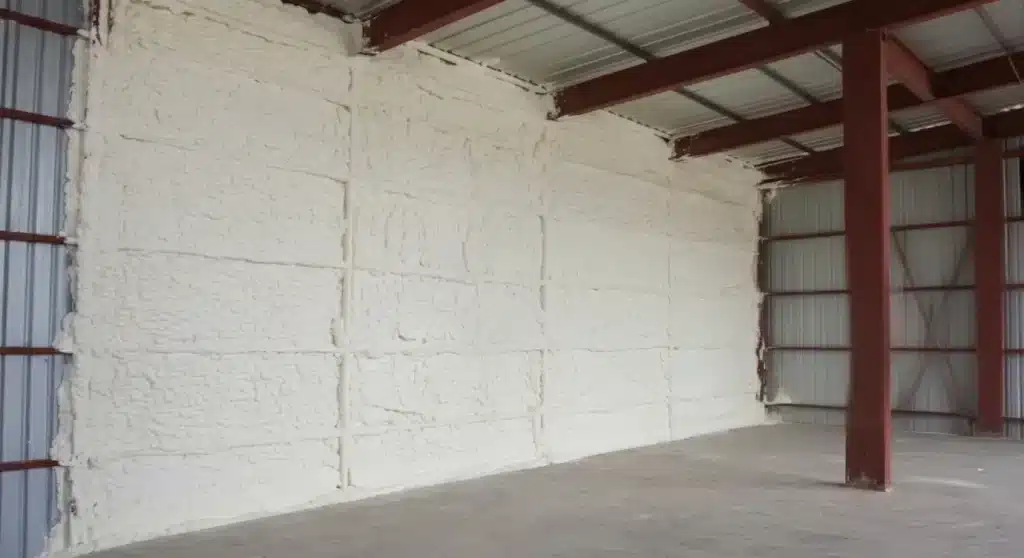
Selecting the best commercial insulation for energy efficiency in Tule Springs requires evaluating your building’s thermal envelope, occupancy patterns, and long-term operational goals. Different insulation materials and installation methods deliver varying R-values, moisture resistance, and ROI timelines, so the optimal choice depends on your facility’s specific needs, budget constraints, and performance expectations. This guide examines spray foam, batt, rigid board, and loose-fill insulation options, providing actionable criteria for Tule Springs commercial property owners and facility managers seeking to reduce energy costs and improve building performance.
Our team at Supreme Spray Foam LV brings specialized expertise in commercial insulation solutions throughout the Las Vegas Valley, including Tule Springs. We understand the unique climate challenges Nevada businesses face and tailor every project to maximize energy savings and occupant comfort.
TL;DR
- Spray foam insulation delivers the highest R-value per inch (R-6 to R-7) and provides air sealing in one application, making it ideal for Tule Springs commercial buildings with metal framing or unconditioned spaces
- Rigid foam boards suit foundation walls and exterior sheathing applications where high compressive strength and moisture resistance are priorities
- Fiberglass batt insulation remains the most budget-friendly option, but requires careful air sealing to prevent thermal bypasses in commercial metal buildings
- Nevada’s extreme temperature swings make air sealing as critical as insulation thickness, directly impacting HVAC runtime and utility costs
- Energy Star data indicates commercial buildings can reduce heating and cooling costs by 15-30% through proper insulation upgrades [Source: Energy Star].
- Building code minimums (R-25 ceiling, R-13 wall for Nevada climate zone 2) should be treated as starting points, not performance targets [Source: U.S. Department of Energy: Building Energy Codes Program].
- Professional air sealing combined with insulation typically yields faster ROI than increasing R-value alone without addressing air leaks
- Local utility rebates and commercial energy efficiency programs in Nevada may offset 10-20% of insulation upgrade costs
Understanding Tule Springs Climate and Commercial Insulation Needs
Tule Springs experiences hot, arid summers with temperatures regularly exceeding 105°F and mild winters with occasional freezing nights. This thermal cycling creates specific challenges for commercial buildings. During summer, uncontrolled heat gain through walls, roofs, and foundations forces HVAC systems to work overtime. In winter, heat loss through the same pathways increases heating costs during those brief cold snaps.
The Nevada desert climate demands commercial insulation that performs across this wide temperature range while resisting moisture intrusion from temperature differentials. Buildings with metal studs or corrugated metal roofs face particular challenges because metal conducts heat rapidly, creating thermal bridges that bypass conventional insulation if not properly addressed.
Spray Foam Insulation: The Premium Performance Choice
Spray polyurethane foam (SPF) insulation has become the preferred solution for high-performance commercial buildings in the Tule Springs area [Source: Spray Polyurethane Foam Alliance]. This material expands on application, filling gaps, cracks, and cavities while providing both insulation and air sealing in a single product.
Open-cell spray foam (ocSPF) offers an R-value of approximately R-3.5 to R-4 per inch with sound-dampening properties, making it suitable for interior wall applications and conditioned attic spaces. Closed-cell spray foam (ccSPF) delivers R-6 to R-7 per inch, adding structural strength to wall assemblies and providing a vapor barrier, which proves valuable in Nevada’s climate where temperature swings create condensation risks.
For commercial buildings in Tule Springs, closed-cell spray foam applied to roof decks, foundation walls, and around building perimeters typically provides the best energy efficiency performance. The air sealing capability eliminates the drafts and thermal bypasses that plague buildings insulated with fibrous materials alone.
Rigid Foam Board Insulation for Specific Applications
Rigid foam insulation boards, particularly extruded polystyrene (XPS) and expanded polystyrene (EPS), serve essential roles in commercial building envelopes. These materials provide high R-values in thin profiles, making them valuable where space constraints exist.
XPS boards (blue, pink, or green colored) offer R-5 per inch with excellent moisture resistance, making them the standard choice for below-grade foundation insulation in commercial applications. EPS boards (white beadboard) provide R-4 per inch at a lower cost but require protective coatings in ground-contact applications.
In Tule Springs commercial buildings, rigid foam sheathing applied over metal studs or concrete masonry walls effectively reduces thermal bridging while providing a continuous insulation layer. This approach works particularly well in buildings undergoing facade upgrades or where interior space cannot be sacrificed for thicker wall cavities.
Fiberglass and Mineral Wool Batt Insulation
Fiberglass batt insulation remains the most commonly installed commercial insulation in older buildings throughout Nevada. While budget-friendly, batt insulation installed in metal stud cavities without proper air sealing often underperforms due to thermal bridging through the metal framing and convection loops within the cavities themselves.
For Tule Springs commercial buildings that already have batt insulation, the priority should be adding continuous exterior insulation and comprehensive air sealing rather than simply adding more batt insulation in the cavities. A study by the Lawrence Berkeley National Laboratory found that air leakage in commercial buildings accounts for 15-25% of total heating and cooling energy loss, often exceeding heat flow through insulation itself.
Mineral wool batt insulation offers superior fire resistance compared to fiberglass, with melting points exceeding 2,000°F, making it preferable for commercial applications with strict fire code requirements. This material also provides better sound control, valuable in multi-tenant commercial buildings.
Real-World Examples from Nevada Commercial Buildings
These examples illustrate how insulation investments in Tule Springs commercial buildings typically generate ROI within 3-7 years, depending on building size, utility rates, and baseline insulation condition.
How to Evaluate Commercial Insulation Proposals
When comparing commercial insulation contractors and proposals in Tule Springs, focus on these critical evaluation criteria:
Ask about thermal imaging inspections. Reputable contractors should conduct blower door tests or thermal imaging to identify air leakage pathways before recommending insulation solutions. Proposals without site-specific assessment of your building’s thermal envelope indicate a one-size-fits-all approach that may miss your building’s unique performance gaps.
Request assembly-by-assembly R-value calculations. Proper commercial insulation design considers whole-building performance, calculating combined R-values for walls, roofs, foundations, and fenestration. Proposals showing only R-values for individual products without assembly-level analysis may not optimize your investment.
Verify air sealing specifications. Any proposal that does not explicitly address air sealing as a separate line item or integral part of the insulation scope should raise concerns. In Nevada’s climate, air sealing typically provides faster energy savings than additional insulation thickness.
Review contractor credentials. Commercial insulation projects require proper licensing, commercial insurance coverage, and documented experience with building envelope science. Request references from similar commercial projects in the Las Vegas Valley.
Common Mistakes to Avoid
Installing insulation without addressing air leaks wastes significant investment because heated and cooled air escapes through gaps before reaching the insulation layer. Always prioritize air sealing before adding insulation.
Choosing R-value alone ignores critical factors like moisture management and air sealing. A wall with R-30 batt insulation in metal studs with 25% thermal bridging effectively performs at R-19, while R-20 spray foam with complete air sealing may outperform it. Evaluate complete wall assembly performance, not just insulation R-values.
Specifying code-minimum insulation levels for new construction misses opportunities for higher-performance envelopes that pay back within typical loan terms. Nevada energy codes meet minimum standards, but incremental costs for upgraded insulation often generate attractive returns given utility rate structures.
Failing to coordinate insulation with mechanical systems and building envelope flashing causes moisture problems and reduced performance [Source: Building Science Corporation]. Commercial insulation decisions should involve your HVAC contractor and ensure proper vapor barrier placement and drainage plane continuity.
Recommendations by Building Type
For metal building construction common in Tule Springs industrial and warehouse facilities, blanket insulation with thermal blocks combined with spray foam at the roof line and around the perimeter typically provides the best value. Direct-born coating systems applied to standing seam roofs offer additional radiant barrier benefits in these applications.
For concrete and masonry commercial buildings, rigid foam sheathing applied to the exterior or interior face provides continuous insulation that eliminates thermal bridging through the structure. Interior applications require careful vapor barrier coordination to prevent moisture accumulation within the wall assembly.
For buildings with high internal heat loads from equipment or occupancy, such as restaurants, data centers, or manufacturing facilities, spray foam insulation with its superior air sealing capability reduces the constant battle against heat intrusion from internal and external sources simultaneously.
Signs You Have Found the Right Commercial Insulation Approach
- The proposal includes a building envelope assessment with identified air leakage sites and thermal bridges
- The contractor explains the moisture management strategy for Nevada’s temperature swings
- The R-value specifications show assembly-level performance, not just product R-values
- The ROI calculation considers your specific utility rates, building hours of operation, and HVAC equipment efficiency
- The scope of work coordinates insulation with flashing, air sealing, and vapor barrier requirements
- The contractor provides references from similar commercial projects in the Las Vegas Valley
- The warranty covers both materials and workmanship for a meaningful duration
Partner with Supreme Spray Foam LV for Your Tule Springs Commercial Project
Our team at Supreme Spray Foam LV specializes in commercial insulation solutions throughout Tule Springs and the greater Las Vegas Valley. We combine thorough building envelope assessments with proven spray foam and rigid foam installation techniques to maximize your energy efficiency investment.
Whether you manage a warehouse, office complex, retail center, or industrial facility, we have the expertise to design and install the optimal insulation system for your building’s specific requirements and performance goals.
Contact our commercial insulation specialists for a no-obligation assessment of your Tule Springs facility. Reach us by email at info@supremesprayfoamlv.com or call 702-904-9895 to discuss your project scope and energy efficiency objectives.
Sources
- Lawrence Berkeley National Laboratory: Commercial Building Energy Sciences: Research on air leakage impacts and thermal bridging in commercial buildings, including studies on the percentage of energy loss attributed to building envelope deficiencies in various climate zones.
- Energy Star: Commercial Buildings Energy Consumption: Data on energy savings potential from commercial building envelope improvements and insulation upgrades across different building types and climate regions.
- Building Science Corporation: Wall Assembly Performance: Technical guidance on vapor barrier placement, moisture management strategies, and assembly-level performance analysis for commercial building envelopes.
- U.S. Department of Energy: Building Energy Codes Program: Nevada commercial energy code requirements, R-value specifications, and compliance guidance for climate zone 2 applications.
- Spray Polyurethane Foam Alliance: Commercial Applications Guide: Industry guidance on spray foam insulation specifications, installation best practices, and performance standards for commercial building applications.