
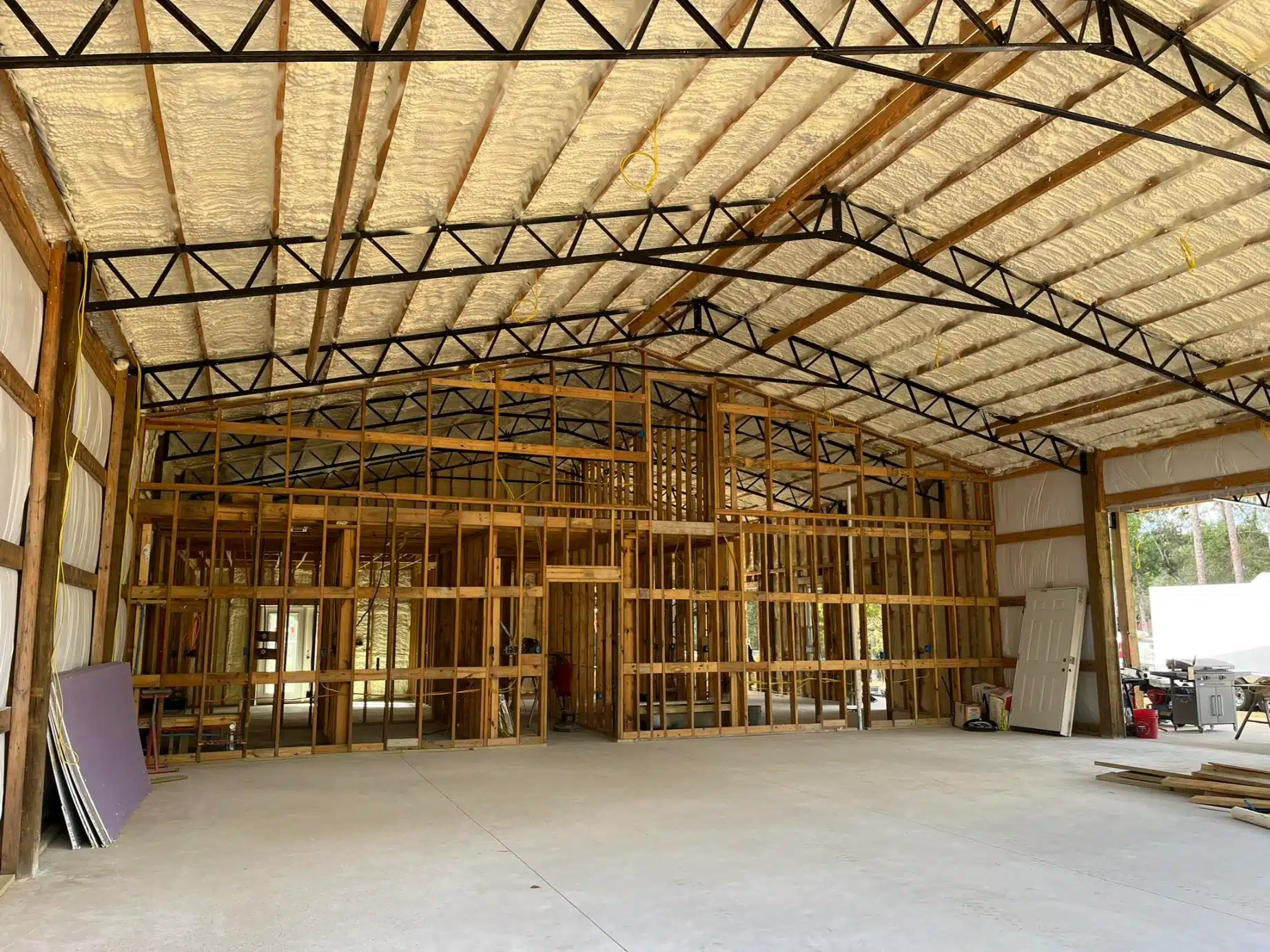
Yes, commercial insulation is one of the most effective solutions for correcting uneven office temperatures in Downtown Las Vegas. When properly specified and installed, insulation addresses the root causes of temperature inconsistency by eliminating air leaks, reducing thermal bridging, and stabilizing the building envelope against extreme desert heat. Las Vegas sits in IECC Climate Zone 3B, where summer temperatures routinely exceed 110 degrees Fahrenheit, and commercial buildings face intense solar gain through roofs and window walls. Without adequate insulation and air sealing, conditioned air escapes through gaps in the building envelope while outside heat infiltrates, creating hot and cold zones that no amount of HVAC adjustment can fully resolve, making effective commercial insulation planning essential for long-term efficiency.
TL;DR
- Downtown Las Vegas falls under IECC Climate Zone 3B, which imposes specific insulation and air-barrier requirements for commercial buildings in the Las Vegas Energy Code.
- Uneven office temperatures are primarily caused by air leaks, missing or degraded insulation, thermal bridging through structural framing, and uncontrolled solar gain on south- and west-facing glass.
- ASHRAE Standard 55 specifies that acceptable thermal comfort requires operative temperatures to remain within 4 degrees Fahrenheit of the setpoint, a target most under-insulated offices in Downtown Las Vegas cannot reliably meet. ASHRAE 55 – Wikipedia.
- Spray foam insulation provides the most complete solution for existing commercial buildings because it simultaneously insulates and air-seals in a single application, unlike fiberglass batts or rigid board insulation.
- The Las Vegas Energy Code requires continuous air barriers across the entire building thermal envelope, including roofs, walls, fenestration, and all penetrations
- Building insulation quality directly impacts employee productivity, with studies showing temperature discomfort is one of the top complaints among office workers nationwide.
- The International Energy Conservation Code classifies commercial buildings with poor insulation as failing to deliver the thermal comfort standards that ASHRAE outlines separately from energy codes, Insulation Institute.
- Proper insulation reduces the workload on HVAC equipment, extending system life and lowering maintenance costs over time.
Why Downtown Las Vegas Office Temperatures Run Hot and Cold
Downtown Las Vegas presents a uniquely challenging environment for commercial buildings. Summer outdoor temperatures frequently spike above 110 degrees Fahrenheit, and buildings with large glass facades absorb significant solar radiation throughout the day. The result is predictable: perimeter offices near windows roast while interior offices freeze due to overcooling from an overworked HVAC system, which is why accurate commercial insulation project budgeting is critical for long-term building performance.
Several factors contribute to uneven office temperatures in commercial buildings:
Air infiltration and exfiltration. Unsealed gaps around windows, doors, ductwork, pipe penetrations, and wall-roof intersections allow unconditioned air to enter and conditioned air to escape. In a high-rise office building, stack effect drives warm air upward through vertical shafts and elevator cores, pulling hot exterior air in through lower-level leaks. This pressure imbalance alone can create temperature swings of 10 to 15 degrees between floors.
Missing or degraded insulation. Many Downtown Las Vegas commercial buildings were constructed decades ago with minimal insulation, often just R-11 fiberglass in walls or none at all. Over time, settling, moisture damage, and renovation projects can further reduce what little thermal resistance exists.
Thermal bridging. Steel studs, concrete slabs, and metal framing members conduct heat directly through the building envelope, bypassing cavity insulation entirely. In commercial construction, thermal bridging can reduce the effective R-value of a wall assembly by 40 to 50 percent of its rated value, as the Department of Energy notes when explaining how heat flows through building components.
Solar heat gain through glazing. West-facing offices in Las Vegas receive intense afternoon sun exposure, while north-facing spaces receive no direct solar benefit. Without adequate insulation on spandrel areas and properly insulated curtain wall assemblies, this solar imbalance translates directly into temperature complaints.
Climate Zone 3B and What the Code Requires
Las Vegas is classified as Climate Zone 3B under the International Energy Conservation Code. The Las Vegas Energy Code, which adopted the 2018 IECC, sets specific minimum requirements for commercial building insulation and air barriers.
| Assembly Type | Climate Zone 3B Minimum | Typical Existing Building |
|---|---|---|
| Roof insulation above deck | R-25 ci | R-0 to R-11 |
| Metal building walls | R-13 + R-6.5 ci | R-0 to R-13 |
| Metal-framed walls | R-13 + R-5 ci | R-0 to R-11 |
| Wood framed walls | R-13 + R-3.8 ci or R-20 | R-0 to R-13 |
| Mass walls | R-5.7 ci | R-0 to R-4 |
| Below-grade walls | No Requirement | R-0 to R-5 |
The ci notation stands for continuous insulation, which means insulation applied in a continuous layer across the entire surface rather than just within framing cavities. Continuous insulation eliminates thermal bridging at studs and joints, which is precisely where most temperature complaints originate.
The code also mandates a continuous air barrier across the building’s thermal envelope. Section C402.5.1 of the Las Vegas Energy Code requires that air barrier joints, seams, and penetrations be sealed for their entire length, and that the air barrier materials demonstrate an air permeability not greater than 0.004 cfm per square foot under a 0.3-inch water gauge pressure differential Las Vegas Energy Code Section C402.5.1. This is where spray foam insulation delivers an advantage over traditional methods because it adheres to surfaces, expands to fill gaps, and creates an airtight seal by nature.
How Spray Foam Insulation Addresses Temperature Imbalances
For existing commercial buildings in Downtown Las Vegas, spray foam insulation solves multiple problems at once:
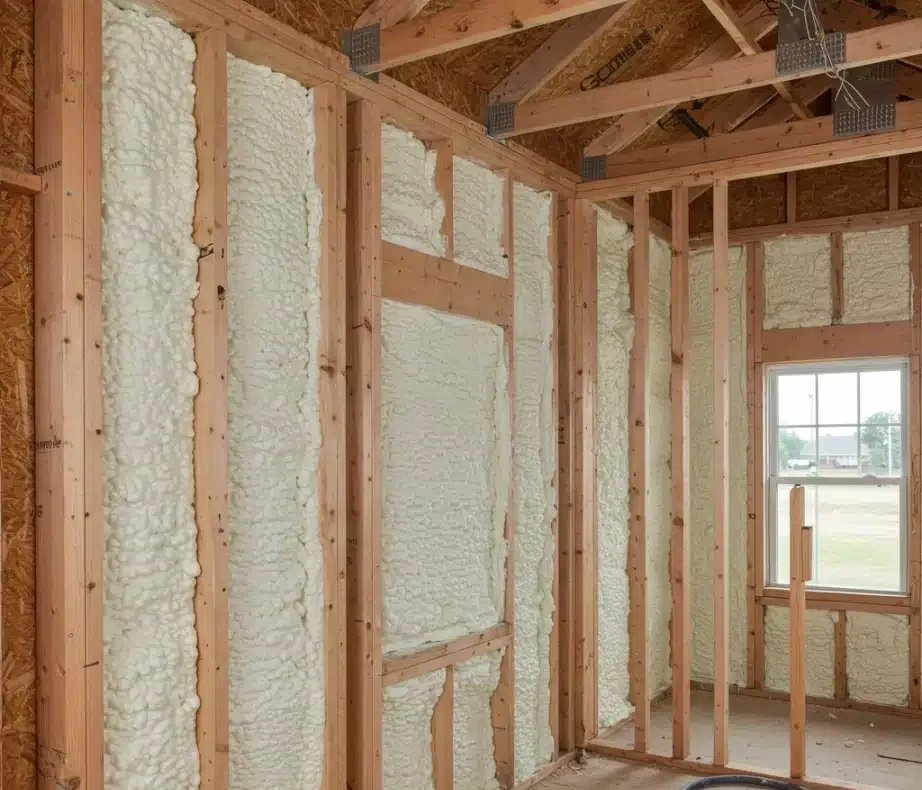
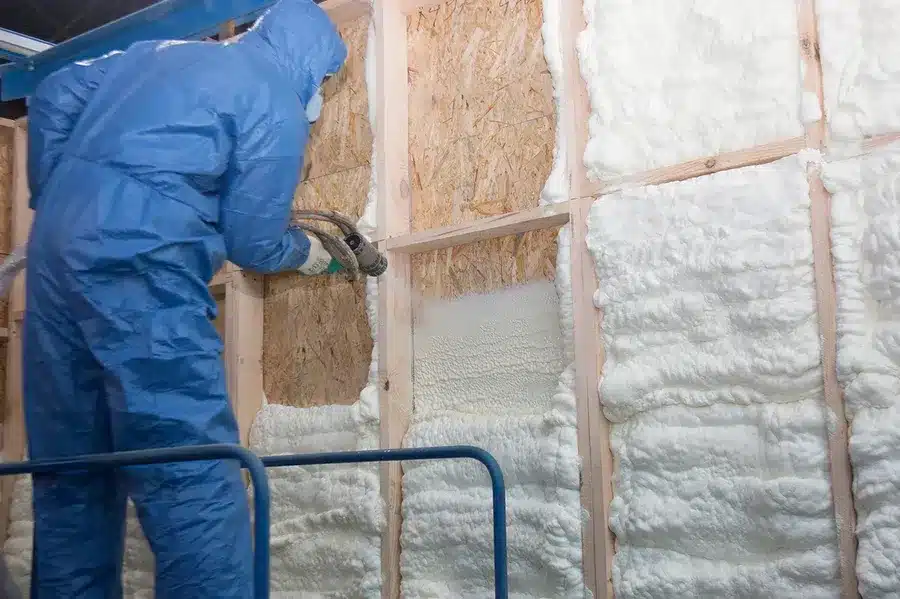
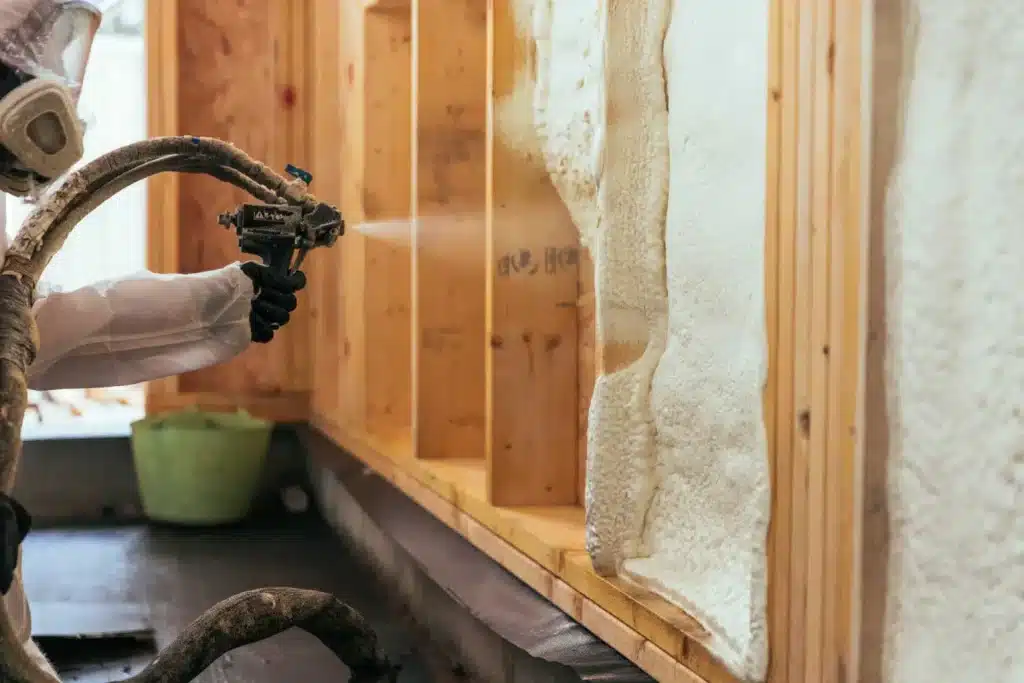
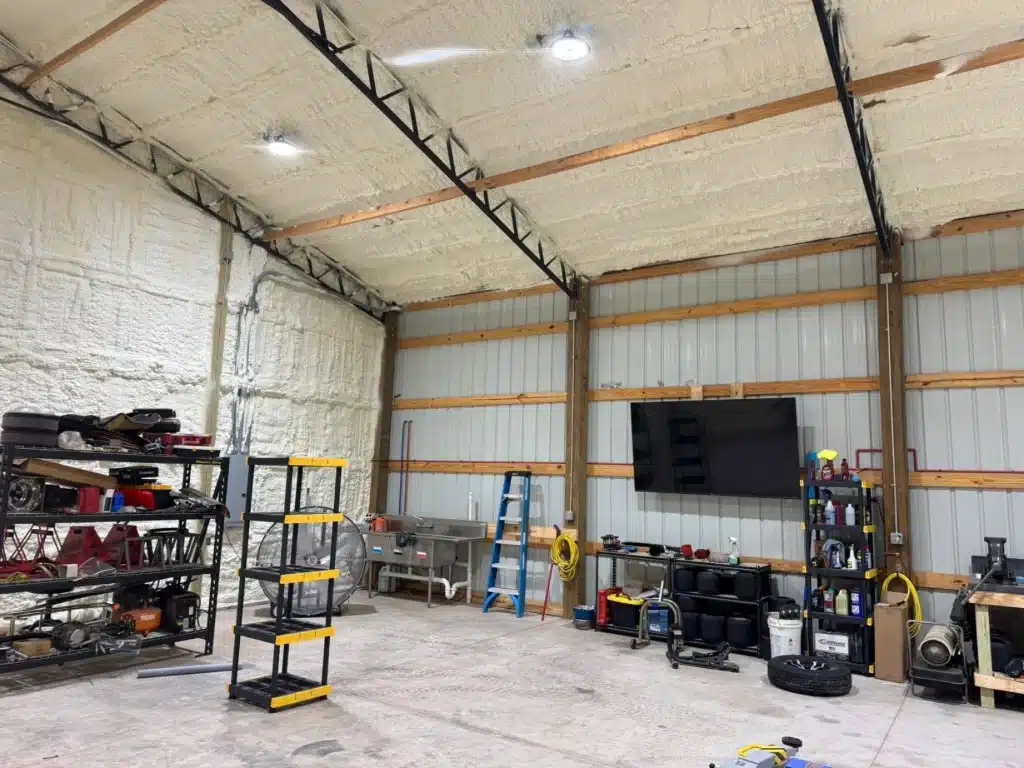
Simultaneous insulation and air sealing. Spray foam expands to fill cavities, cracks, and penetrations that batt insulation cannot reach. This dual function means our crews address both thermal resistance and air leakage in a single step. Closed-cell spray foam also serves as a recognized air barrier material in the energy code, qualifying without additional membrane installation.
Superior R-value per inch. Closed-cell spray foam delivers approximately R-6 to R-7 per inch, compared to roughly R-3.2 per inch for fiberglass batts. In thin-wall commercial construction, this higher per-inch performance matters because cavity depths are limited. A 2-inch application of closed-cell spray foam achieves R-12 to R-14, matching or exceeding the code requirement for continuous insulation on above-grade walls in Climate Zone 3.
Moisture resistance. Closed-cell spray foam acts as a vapor retarder at 1.5 inches of thickness, which is essential in Las Vegas, where monsoon humidity and occasional rain penetration threaten insulation performance and indoor air quality.
Conformance to complex geometries. Curtain walls, irregular roof decks, retrofit wall systems, and around structural steel are all areas where spray foam excels. These geometries are nearly impossible to insulate effectively with rigid boards or batts.
Insulation and Thermal Comfort: The ASHRAE Connection
Building energy codes address efficiency, but thermal comfort for occupants is governed by a separate standard. ASHRAE Standard 55 specifies that acceptable thermal environments should keep operative temperature fluctuations within 2.2 degrees Fahrenheit within any one hour and maintain a Predicted Mean Vote (PMV) between -0.5 and +0.5 for at least 80% of occupants ASHRAE 55. When an office building cannot hold a steady temperature due to air leaks and underinsulated walls, it fails this comfort standard even if the HVAC system is properly sized.
The Insulation Institute confirms that thermal comfort is a major driver of occupant satisfaction, and that a building with significant temperature variations will result in disgruntled occupants, regardless of how the HVAC system performs. They further point out that meeting code-minimum insulation is not a guarantee of occupant satisfaction. In fact, ASHRAE has a separate standard for occupant expectations that exists independently from energy code requirements.
This distinction matters for building owners and facility managers in Downtown Las Vegas. Employees working in thermally uncomfortable spaces file more complaints, show lower productivity, and have higher absenteeism. In a competitive downtown office market, maintaining consistent comfort through insulation is a direct operating advantage.
Real-World Scenarios: Downtown Las Vegas Commercial Insulation Projects
Our team has encountered recurring temperature patterns in commercial buildings across Downtown Las Vegas. Here are representative examples of common problems and how we addressed them:
| Scenario | Building Type | Problem | Solution | Outcome |
|---|---|---|---|---|
| South-facing law firm | 6-story professional office | Perimeter offices 10-15 degrees hotter than interior, attorneys on floors 4-6 complained daily | Closed-cell spray foam applied to spandrel areas and curtain wall cavities | Temperature variation reduced to within 3 degrees across all floors |
| Downtown financial services firm | 3-story brick building | Cold complaints in winter despite running heating constantly, hot spots in server room, high energy bills | Open-cell spray foam in wall cavities plus dense-pack application in ceiling plenums | Eliminated drafts, reduced heating runtime by 40%, server room temperature stabilized |
| Retail tenant improvement | Ground-floor retail space in mixed-use tower | Front-of-house was hot from sun exposure while stockroom was cold, customer complaints | Closed-cell foam on exterior walls plus air sealing at all penetrations | Consistent temperature between sales floor and back-of-house |
| Medical office retrofit | 2-story medical clinic | Exam rooms were uncomfortable, patient satisfaction scores dropping, HVAC replacement quotes received | Spray foam insulation on walls and roof deck, duct sealing | HVAC capacity was adequate all along; no replacement was needed |
| Historic building renovation | 1920s-era office building | No wall insulation, single-pane glazing, extreme temperature swings, condensation in winter | Closed-cell spray foam injected into wall cavities, roof deck insulated with rigid foam, window upgrades | Year-round temperature stability achieved, energy bills cut substantially |
Factors That Affect Insulation Performance
Not all insulation projects deliver the same results. Several variables determine how effectively insulation addresses temperature problems:
Building age and construction type. Pre-1980 buildings typically have little to no wall insulation, and replacing that insulation requires careful planning. Steel-frame construction has higher thermal bridging than wood-frame or concrete, which makes continuous insulation or spray foam essential rather than cavity-only products.
Installation quality. Insulation only works when installed correctly. Gaps, voids, and compression all reduce the effective R-value. In spray foam applications, proper substrate preparation, correct mixing ratios, and adequate thickness are all essential to achieving rated performance. Our installers follow manufacturer specifications for every project to ensure reliable spray foam services in Downtown Las Vegas.
Moisture management. Las Vegas monsoon season introduces humidity that can degrade certain insulation types. Spray foam is inherently resistant to moisture absorption, but any insulation must be paired with proper vapor barrier strategies to prevent condensation within wall assemblies.
HVAC system sizing. Insulation reduces the heating and cooling load on the HVAC equipment. In buildings where HVAC systems were oversized to compensate for poor insulation, upgrading the insulation may allow right-sizing the equipment in the future, which saves on both first costs and operating costs. The Las Vegas Energy Code requires that HVAC equipment capacity not exceed the smallest available size that meets calculated loads, Las Vegas Energy Code Section C403.3.1.
Duct insulation and sealing. Ductwork running through unconditioned spaces in Downtown Las Vegas office buildings is a major source of temperature complaints. Uninsulated supply ducts lose up to 30% of their energy before conditioned air reaches the registers. Duct insulation and sealing should always accompany building envelope insulation upgrades.
Actionable Strategies for Building Owners and Facility Managers
If you are managing a commercial building in Downtown Las Vegas, these steps will help you determine whether insulation is the right fix for your temperature problems:
- Conduct a building envelope assessment. Hire a qualified energy auditor or insulation contractor to evaluate your current insulation levels, identify air leakage points, and document thermal bridging throughout the building. Blower door testing provides a measurable air leakage rate to compare against the code maximum of 0.40 cfm per square foot of envelope area at 75 Pascals.
- **Map temperature complaints. Track which offices or zones receive the most complaints and correlate them with envelope exposures. South and west-facing perimeter zones almost always point to solar gain and inadequate spandrel insulation. Upper floors in tall buildings often suffer from stack-effect-driven infiltration.
- Prioritize spray foam for retrofit applications. In existing buildings, spray foam delivers the best combination of R-value per inch, air sealing, and ease of installation in constrained spaces. It is the most practical solution for buildings that cannot accommodate a major renovation.
- Address duct systems simultaneously. Ensure all ductwork outside the thermal envelope is insulated to at least R-8 in Climate Zone 3 and that all joints and seams are sealed. Duct leakage and insulation problems can account for a significant share of temperature complaints even in well-insulated buildings.
- Plan for HVAC recommissioning. After insulation upgrades, have your HVAC contractor rebalance the system. Equipment that was sized for the old, leaky building will now be oversized, which means it will short-cycle and create new comfort problems if left unadjusted.
Comparing Insulation Types for Commercial Retrofits
Different insulation materials perform differently in commercial retrofit scenarios. Here is how the most common options compare for Downtown Las Vegas buildings:
| Insulation Type | R-Value per Inch | Air Barrier | Moisture Barrier | Best Application |
|---|---|---|---|---|
| Closed-cell spray foam | R-6.0 to R-7.0 | Yes (at 1.5 inches) | Yes (at 1.5 inches) | Wall cavities, roof decks, irregular surfaces, existing walls |
| Open-cell spray foam | R-3.5 to R-3.7 | Yes (at 4.5 inches) | No | Wall cavities, ceiling plenums, sound attenuation needs |
| Fiberglass batts | R-3.1 to R-3.4 | No | No | New construction wall cavities with standard framing |
| Rigid foam board | R-4.0 to R-6.5 | Only with taped joints | Varies by product | Continuous exterior insulation on new construction |
| Mineral wool | R-3.3 to R-4.2 | Only with taped joints | Varies by product | Fire-rated assemblies, sound partitions |
For retrofitting Downtown Las Vegas commercial buildings, closed-cell spray foam offers the strongest combination of thermal performance, air sealing, and application flexibility. Open-cell spray foam provides a lower-cost option when moisture barriers and higher R-values are not required.
Get a Professional Assessment
If your Downtown Las Vegas office building has persistent temperature complaints, insulation upgrades are one of the most impactful investments you can make. Our team at Supreme Spray Foam LV has extensive experience working in downtown commercial properties, from high-rise towers to historic renovations. We evaluate every building envelope, recommend the right insulation strategy for your specific construction type, and install materials that meet or exceed code requirements for Climate Zone 3B. Call us at (702) 904-9895 or email [email protected] to request a quote, or schedule a building assessment today and find out exactly what is causing your temperature problems.
FAQs
Q: How long does it take to complete a commercial insulation retrofit in an occupied office building?
A: Most commercial insulation projects in Downtown Las Vegas can be completed in phases to minimize disruption, typically finishing one floor or zone at a time over several weekends or off-hours shifts.
Q: Can insulation upgrades qualify for energy code compliance on an existing building?
A: Yes, commercial insulation upgrades on existing buildings can demonstrate compliance with the Las Vegas Energy Code through the component performance alternative or whole-building performance methods outlined in Chapter CE 4.
Q: Does spray foam insulation require special fire protection in commercial buildings?
A: Spray foam installed in occupied commercial spaces must meet ASTM E84 or equivalent fire testing requirements, and may need an ignition barrier or thermal barrier depending on the application and building code classification.
Q: Will insulation alone fix all temperature problems in my office?
A: Insulation addresses the building envelope, which is the most common cause of uneven temperatures, but HVAC issues like unbalanced airflow, undersized equipment, or broken controls can contribute and should also be evaluated.
Q: How do I know if my building needs insulation or an HVAC upgrade first?
A: A blower door test, thermal imaging survey, and load calculation will identify whether envelope deficiencies or mechanical system problems are the primary driver of your temperature complaints.
Sources
- Las Vegas Energy Code 2018 – Chapter CE 4 Commercial Energy Efficiency – Official commercial building insulation R-value requirements, air barrier specifications, and HVAC equipment sizing rules for the Las Vegas jurisdiction under IECC Climate Zone 3.
- Insulation Institute – Why Insulate Commercial Buildings – Research on thermal comfort as an occupant satisfaction driver and the distinction between code-minimum insulation and actual comfort performance in commercial facilities.
- Department of Energy – Insulation – Explanation of how insulation resists heat flow, the role of R-values, thermal bridging through framing, and how heat moves through conduction, convection, and radiation.
- ASHRAE Standard 55 – Wikipedia – Description of the ANSI/ASHRAE Standard 55 thermal comfort standard, including acceptable temperature ranges, PMV methodology, and the difference between building code requirements and occupant comfort expectations.
- ENERGY STAR – Why Seal and Insulate – EPA data on energy savings from combined air sealing and insulation upgrades, along with comfort improvement documentation for buildings with compromised envelopes.